Showing posts with label France. Show all posts

Sunday, 10 April 2022

The Louvre: A Museum Accessible to All?


[This image shows the apparently now defunct Tactile Gallery at the Louvre. On a sign in the left of the image we read ‘Galerie d’étude I : espace adaptée aux visiteurs non et malvoyants’ {Study Gallery I: space adapted for blind and visually impaired visitors'). Next to this sign is a bare room closed off by a metal gate. The room has stone walls and tiny windows. It seems to be bathed in creamy yellow light. It is completely empty. It looks like a designer prison cell.]

** UPDATE: 13/04/22 ** The Louvre got in touch the day after I published my post. They apologized for the current situation, thanked me for my feedback and have promised to work on better communication of their offerings to all concerned. They gave me a link to the audio-described tour of the current exhibition and reassured me that the Tactile Gallery has not gone for good, but is being renovated.

I am used to being disappointed by museums' accessibility offerings. (Examples here and here). But I was not expecting to have my worst experience at one of the world's most famous museums. According to their website, the Louvre is "accessible à tous" (accessible to everyone). I was especially looking forward to visiting the Petite Galerie which has a very promising description on the museum website:

The Petite Galerie is a dedicated space for disabled visitors. Entirely accessible, it is equipped with tactile ground surface indicators. A braille booklet is lent free of charge and a downloadable guided tour with audio descriptions is available on the Petite Galerie app.

La Petite Galerie est un lieu d’accueil privilégié pour les visiteurs en situation de handicap. Entièrement accessible, l'espace propose des dispositifs adaptés : bande de guidage podotactile, prêt gratuit d’un livret tactile remis, parcours audio-décrit téléchargeable sur l’application "La Petite Galerie".

After feeling frustrated by the general lack of access for blind people elsewhere in the Louvre, I was expecting great things from the Petite Galerie. I'm not a fan of 'special' rooms for disabled visitors, but some provision, even if marginalized, is better than none. 

When we arrived, we found that the Petite Galerie does indeed have an audio described tour of a handful of items in the 'Figures d'artiste' exhibition on their app. Sadly, this exhibition closed last year: the current exhibition is not audio-described and the app has not been updated. To add insult to injury, the out-of-date audio is still on the app. Massive disappointment. The gallery attendants had no idea why this year's exhibition has not been described. They did, however offer me a tactile booklet that accompanies the current exhibition, 'Venus d'ailleurs: materiaux et objets de voyage' (From Afar: Travelling Materials and Objects).

Given that the 'Petite Galerie' is specifically designed for disabled visitors, I was pretty shocked and upset that I couldn't access audio descriptions of any of the 50 of so exhibits. But my friend and I decided to try the tactile booklet anyway. Here is what we found:

The booklet contains 2D relief drawings of 7 works; 6 objects and 1 painting. There is also a tactile plan of the exhibition which was supposed to help us locate the objects. The first two rooms in the exhibition have 'guidage podotactile' (raised floor markings) that are also shown on the tactile map. (Oddly the raised markings stop at the entrance to the third and final room: blind people are not welcome there). The AD of the previous exhibition explains how to find each object. Without it, we found it hard to locate the objects, especially because, as my friend pointed out, some of them are extremely small.

The tactile reproduction of the painting apparently does quite a good job of capturing the shapes and textures of the five shells:

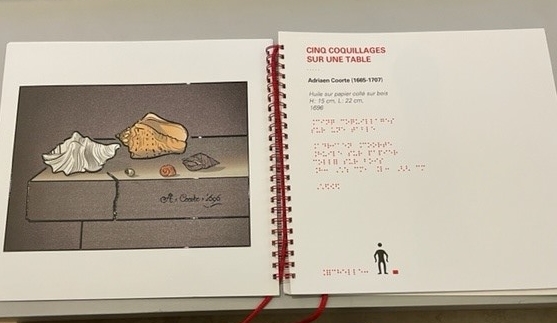
An oil painting of 5 shells in an ornate frame


[The top image shows an oil painting of 5 shells in an ornate frame; the lower image shows the tactile reproduction of the painting on the left-hand page of the tactile booklet; printed and braille information about the painting is on the right-hand page.]

In fact, my friend thought that non-blind visitors would appreciate the details given by the tactile drawing, which are not necessarily visible in the painting. This is great if you care about the shells themselves, but less great if you want a tactile experience equivalent to how a non-blind person might look at the painting. Reproducing details that a non-blind person can't see, gives a skewed idea of how the painting looks. 

The booklet gives basic information (title, artist, materials, dates, dimensions) in French in grade 1 (uncontracted) Braille and slightly larger than standard print. But there is no explanation of what the painting looks like, why it is significant or how it fits into the exhibition as a whole. Even more frustratingly, the exhibition's information panels and curator notes are not translated into Braille but are only available as wall panels in very small type. The tactile booklet gave me no sense of the exhibition as a whole.

Things got even worse when we compared the tactile reproductions of the 6 objects with the artefacts on display. Creating tactile drawings is tricky: you need to provide enough information to make the object recognisable, but too much information can be confusing, especially if not accompanied by an audio explanation. Unfortunately, the Louvre has decided that it is best to provide minimal information: this results in insultingly simplistic representations that feel more like children's' book illustrations than representations of historic artefacts. Compare the tiny elephant figure pictured below with its tactile representation and you will understand what I mean: 


[The top image shows a tiny bronze elephant statue. I have no idea what it was used for or where it is from. It is standing on a wedge-shaped platform so that it is at an angle with its front feet slightly higher than its back feet. It is in a display case with a mirrored back in which my face and phone are reflected. The second image shows a basic elephant shape in relief on the left-hand page of the tactile booklet. The right-hand page contains minimal information in print and braille.]

Nothing in the tactile booklet tells me how the elephant actually feels, and I have to use my own understanding of the one measurement provided (h: 9cm) to work out how the scale of the reproduction relates to the original. More worryingly, there is no acknowledgement that the practice of transforming 3D objects into 2D tactile representations is deeply flawed. Nothing in the reproduction gives a sense of the actual elephant. What we have here, at best, is a generic picture of an elephant: I am pretty sure that most blind people are familiar with the concept of an elephant. At worst we have an incredibly infantilising and insulting tactile drawing that tells us nothing about the artefact or its place in the exhibition. (Here is not the place to get into the dangerously Orientalist decision to use an elephant to represent the exotic other.....). 

The tactile reproductions of the other objects were not much better. The elephant obsession continued with an 'olifant' (horn) made out of ivory. 


[The top image shows an 'olifant' hanging in a display case. There is a reflection of me in the background. The horn seems to have intricate markings carved into it. The lower image shows a double-page in the tactile guide. On the left, a tactile drawing of the horn. Two areas of the horn are outlined in red; enlarged reproductions of them are included below the drawing of the horn. On the right, minimal details about the horn are included in print and braille.]

This time there was an effort to include some of the details on the horn in separate drawings of specific elements. My friend noticed an explanatory panel next to the horn. It gives several sentences of interpretation in English and French as well as a map illustrating the object's provenance. The text on the panel is too small for me to read. None of it is included in the tactile booklet.


[This image shows a display panel next to the horn. The text is in French and English. It is printed too small for me to read (perhaps 10 or 12 point). There is also a line-drawn map with a shaded area indicating where the object is from. I can see enough to guess it is Middle-Eastern.]

Almost all the objects in the exhibition are in Perspex display cases. But there was one object - another ivory horn - that was displayed without a case. I was enjoying touching it until my friend noticed what we thought might be a 'do not touch' symbol next to it. (The irony that I could not see the sign did not escape us).


[This image shows a larger elephant tusk or horn. It is not in a case and is invitingly at hand level. Below the object there is a short explanatory text. There is also a panel with two images: both crossed out by a red diagonal line: one is a hand with an extended finger; the other is a speaker with sound waves coming out of it and 'durée 8 minutes' written next to it: can this mean that there used to be an 8-minute AD for this object that is no longer available?]

To be fair, the gallery staff were pretty embarrassed and appalled by my experience. They are under-paid and over-worked and none of this is their fault. They suggested that we report the situation to the visitor experience team. They also recommended going to explore the Louvre's famous Tactile Gallery, one of the first tactile sculpture galleries in Europe.

On the recommendation of the gallery staff, we did go and talk to visitor services about the Louvre's offer for blind and partially blind people. When I explained that the Petite Galerie app no longer includes AD, they suggested that we avail ourselves of the 'standard' audio guide instead. However, further questions revealed the limitations of this standard audio guide for blind visitors. No, there aren't any audio descriptions of works included in the standard guide. Yes, there is explanatory, contextual and interpretative material only. Yes, you have to be able to read a number placed next to each work and enter it into a touch tablet. No, this system isn't accessible to non-accompanied blind people. No, there are no tactile handsets or braille or large-print transcripts. No, the objects in the Petite Galerie are not included in the 'standard' audio guide. Yes, it probably is true that the museum is not accessible to blind people.

Our final stop was the famous Tactile Gallery. The Gallery opened in 1995 and soon became a flagship gallery for museum accessibility. When I asked my not-so-helpful visitor services helper for directions, I was stunned by his response: "Ah, Madame, ça n'existe plus!" (Oh, Madam, that no longer exists). nfortunately the attendants in the Petite Galerie did not know that the Tactile Gallery had been shut down. This is not just a temporary Covid Closure. As the image at the top of the page, and these two images, show, the Tactile Gallery has apparently gone for good:


[The top image shows a sign reading ‘Galerie d’étude I: espace adaptée aux visiteurs non et malvoyants’ {Study Gallery I: space adapted for blind and visually impaired visitors'). The lower image shows an empty room closed off by a metal gate. The room has stone walls and tiny windows. It seems to be bathed in creamy yellow light. It is completely empty. It looks like a designer prison cell.]

No-one in the museum could tell me why the Tactile Gallery has been abolished. If I were being charitable I would guess that it has been abandoned because it will become redundant once the Louvre makes every object properly accessible to all. Until that day comes, here is my advice for the Louvre:

Remember that 'access' does not just mean physical access to a space. It also means giving people information and experiences in ways that work for them. There is no point offering to meet me at a bus stop and guide me into the Louvre if I then can't access any of the art once I am inside your 'accessible' building. 

Be honest: if there is no longer audio description, update your app and your website so that I don't waste my time and money. Your website promises something you don't deliver; you raised my expectations and that made my disappointment and frustration worse. It is rare that museums make me cry but you very nearly managed it.

Rethink your priorities. You are one of the most famous museums in the world. Don't you think that everyone should have access to your collections? Surely you could invest some of the profit you make from entrance fees, and shop and café mark-ups into proper permanent access? How about leading by example?

Celebrate access: as I have shown elsewhere, creative audio description benefits all visitors. Instead of marginalizing disabled visitors make us the centre of your offering. No non-disabled visitor is ever going to say 'I hate this museum, it is too accessible'.

Don't hide behind excuses around logistics / finance / admin / aesthetics: if small museums like the Royal Holloway Picture Gallery or the Guildhall Museum can make their collections accessible, so can you.

Involve disabled people in curation and exhibition design: even highly qualified non-blind people are not as good at designing accessible exhibits as the people who use them.

Thursday, 7 September 2017

Reviewing Blindness in French Fiction out now!


This image shows the front cover of Reviewing Blindness in French Fiction by Hannah Thompson. Above the title, a hand is shown reading a sheet of Braille. 


I am delighted to announce that my book Reviewing Blindness in French Fiction has been published by Palgrave in their Literary Disability Studies series.

In this work I show how and why French fiction is fascinated with visions of blindness by identifying and analysing the complicated relationship between writers, readers and fictions of blindness that permeates French fiction. Blindness is a mysterious phenomenon. It arouses curiosity and invites discussion. It is also a multi-layered and multi-faceted collection of narratives. Writers are drawn to blindness precisely because blindness itself is a collection of stories. The stereotypes, clichés and misconceptions which constitute what most non-blind people describe as “blindness”, have been described by David Bolt as a literary “metanarrative”. Whilst many French depictions of blindness reinforce and conform to the various strands of Bolt's mostly negative metanarrative, my work focuses on more positive depictions which question, undermine or deconstruct the prevailing myths of blindness. I re-view a selection of the most interesting, surprising and moving depictions of blindness in French fiction by authors including Brigitte Aubert, Honoré de Balzac, Georges Bataille, Tonino Benacquista, Maxime du Camp, Lucien Descaves, André Gide, Jean Giono, Hervé Guibert, Victor Hugo, Thérèse-Adèle Husson, Paul Margueritte, Guy de Maupassant, Marc Monnier, Maurice Renard, Didier Van Cauwelaert, Fred Vargas and Romain Villet.

Works by these authors contest and overturn received ideas of blindness through both the form and the content of their fiction. When blindness sheds its metaphorical meanings and exists as part of a narrative on its own terms, it becomes a positive signifier of change, desire, success and enhanced subjectivity.

Overview:

Chapter 1: Introduction
I begin my re-viewing of French fictional depictions of blindness by calling for a rejection of negative misconceptions of blindness. The most interesting depictions of blindness in French fiction are those which challenge stereotypes of blindness and the emerging field of Critical Disability Studies provides us with the theoretical tools needed to do this.

Chapter 2: The French Metanarrative of Blindness
I survey those literary depictions of blindness which reinforce the metanarrative of blindness discussed by David Bolt. Maupassant’s short story ‘The Blind Man’ evokes the blindness-ignorance and blindness-darkness synonymies whilst also using nominalisation and generalisation to dehumanise its protagonist. Blind male characters are represented as weaker, less active and less able to access language than their non-blind peers. Female blind characters, on the other hand, are often portrayed as meek and passive victims of their condition. Non-blind characters routinely trick, pity and manipulate blind characters in these typhlophobic fictions of blindness. The chapter ends with an analysis of André Gide’s The Pastorale Symphony which shows how myths of the blind mystic and of sensory compensation emphasise blind protagonists’ otherness.

Chapter 3: The Creative ‘Look’ of the Blind ‘Seer’
This chapter marks the beginning of  my sustained examination of the creative possibilities of blindness. Through close-readings of novels and short stories by Honoré de Balzac, Victor Hugo, and Thérèse-Adèle Husson, I show that the unseeing gaze of the blind protagonist often transforms him or her into a surrogate narrator who is paradoxically more adept at gathering information than the sighted narrators usually present in realist texts. In works which feature blind narrators, the process of information gathering and dissemination becomes an even more overt challenge to the traditional supremacy of the sense of sight.

Chapter 4: Non-Visual Language and Descriptive Blindness
This chapter considers works by Hervé Guibert, Jean Giono, Romain Villet and Lucien Descaves which use blind characters to sensitise the reader to the descriptive power of non-visual language. In Blindsight, Guibert uses visually impenetrable language to stimulate his readers’ other senses whereas in The Song of the World, Giono mobilises the presence of a blind character to signal his use of non-visual description throughout the novel. My detailed reading of Descaves’ extraordinary novel of blindness, The Trapped, reveals not only that non-visual description is a highly effective way of communicating with a non-blind reader, but that Descaves includes braille in his novel in order to temporarily exclude his sighted readers.

Chapter 5: Male Desire and the Paradox of Blind Sexuality
In the first part of this chapter, I use readings of scenes of castration and pornographic pleasure from Hervé Guibert’s Blindsight and Georges Bataille’s Story of the Eye to suggest that both authors undermine the traditional dominance of the voyeuristic male gaze. In the second part, I explore how the non-visual eroticism suggested by the blindness-castration association is manifested in the descriptions of blind male desire found in Lucien Descaves’s The Trapped and Romain Villet’s Look.

Chapter 6: Silenced Sexualities: Listening to the Voice of the Blind Woman
Unlike the examples of blind male desire discussed in the previous chapter, the voices of blind female characters are much harder to hear. Blind female protagonists often remain silent in their texts: they are frequently unspeaking objects of the sighted male gaze and when they do speak, their words are often filtered through the voice of the male narrator. Detailed readings of Thérèse-Adèle Husson’s Reflections and Didier van Van Cauwelaert’s Jules shows how it is possible for a blind woman to subvert many of the stereotypes of blindness in order to express herself.

Chapter 7: Blind Assassins
This is the first of two chapters to focus on a specific literary genre, in this case the roman noir. Close readings of detective fiction by Fred Vargas and Brigitte Aubert show how this traditionally ocularcentric genre can be subverted by the presence of blind characters who encourage both other characters and the reader to reconsider the assumptions they routinely make about blindness. By comparing how male and female blind detective figures relate differently to the crimes they are solving, I also show, in chapters 5 and 6, that blind men and blind women are treated differently by both friends and enemies.

Chapter 8: Science, Fantasy and (In)Visible Blindness
Science fiction’s fascination with invisibility tells us more about blindness than it does about vision. Taking Maurice Renard as my main example, my detailed readings of The Blue Peril and The Doctored Man show that rather than reinforcing the supremacy of vision in the hierarchy of the senses, narratives which present us with different ways of seeing can in fact be read as celebrations of the powers and possibilities of blindness.

Chapter 9: Conclusion
I use Tonino Benacquista’s critically acclaimed 1991 roman policier, La commedia des rat
és to show how French fiction’s most interesting representations of blindness are those which draw attention to a range of stereotypes of blindness before using surprising imagery, plot twists, characterization or stylistic features to undermine the reader’s expectations. This novelistic subversion encourages the reader to look again – or re-view – his or her understanding of blindness. Blindness is best understood as a multi-faceted and multi-layered collection of narratives which, when re-viewed together, testify to the powerfully creative potential of blindness. 

Reviewing Blindness in French Fiction is available as a hardback or e-book from Palgrave or amazon. If you are interested in reviewing the book, please get in touch.  

Thursday, 2 March 2017

Audio Description in the Art Gallery


This image is a screenshot from the Ashmolean website. It is made up of three panels. The left-hand panel gives the title of the exhibition, in the middle is a picture of a mother and child which looks like a Picasso (but in fact isn't), and on the right is a panel with further information. 

In the February issue of their Museums Journal, the Museums Association included an article with the somewhat 'no-brainer' title 'Museums need to do more to welcome disabled visitors'. According to the article, whilst museums are keen to point out that their galleries are accessible to wheelchair riders, and that guide dogs are welcome, they do not always make the actual collections accessible to partially blind visitors. This is particularly true of temporary exhibitions and the Ashmolean Museum's current blockbuster show, 'From Degas to Picasso' seemed to be no exception. The show's website reproduces the frustratingly familiar misunderstanding of access evoked in the article. To the Frequently Asked Question: 'Is the exhibition accessible?' they provide the chirpy but misleading response:
Yes. Access to the exhibition is via lift and the entire exhibition is wheelchair accessible with handheld labels available.
Undeterred, I phoned up to ask about availability of audio description headsets, large-print labels or a Braille catalogue, I was not surprised to be told that none of the above existed. But I was delighted to be offered a 1-to-1 audio described tour of the exhibition from a knowledgeable expert-guide.

When I got to the museum, my guide Lynne was waiting for me exactly where I was expecting her to be. She introduced herself, led me up to the exhibition and gave me an overview of the history of the collection and its contents before we went into the three-room show. She then provided me with descriptions of a selection of the pictures, coupled with the kind of information that brings art and its history to life. My friends and family have been describing pictures to me for years, but none of them (apart from my Dad) know enough about art history to combine the kind of objective description used by audio describers with an insight into artistic techniques, context and the painting's place in the collection more generally. As Lynne adapted her descriptions to my interest, sight levels and knowledge of nineteenth-century French art, the tour became a collaborative response to the pictures. Indeed, at one point another gallery-goer chipped in with her interpretation of a detail in one of the exhibits.

The tour had other unexpected consequences. Lynne encouraged me to break the unspoken rule of gallery going and get as close to the paintings as I could. With my nose pressed up against the glass, and her fingers guiding my eyes, I could see globs of paint, brush strokes and chalk marks that I would never have dared to discover otherwise. I also noticed that as we moved from the nineteenth-century realism of David, Ingres and Millais, to the cubist work of Picasso and Braque, Lynne's descriptions reflected the visual difficulty of the pictures. As we together deciphered Albert Gleize's cubist portrait of Stravinsky, for example, our inability to find the language to describe the disjointed shapes on the canvas reflected the picture's own challenge to normative ways of both painting and seeing. I like to think that the cubists' challenge to conventional representation was being echoed in our unconventional approach to the guided tour. Part tour, part audio description, our collaborative exploration of a selection of the exhibition's works felt like a wonderfully immersive way of sharing different ways of seeing and talking about art.

I feel extraordinarily lucky to have been able to benefit from Lynne's time and expertise. But I am sure there are lots of partially blind people who will never access this art. Some will be put off by the website's failure to mention audio described tours. Those who are persistent enough to find the right number to call (FYI at the Ashmolean, access is handled by the education department), may not be free on the same days and times as Lynne. (As is so often the case tours are not usually offered on weekends or in the evening). Or they might be put off by the 1-to-1 format. This is wonderful art that everyone should be able to experience. Surely it can't be that difficult or expensive to record or transcribe Lynne's words and make them available in audio, large-print and braille versions for anyone who wants them.


Monday, 11 July 2016

Book Review: 'Jules' by Didier van Cauwelaert


Since I discovered his Goncourt-winning Un aller simple in 1995, I have always loved Didier van Cauwelaert's quirky, touching and gently ironic novels. But my heart sank when I learnt that his most recent work Jules (Albin Michel: 2015) tells the story of a blind woman whose sight is miraculously restored. I was worried that this would be a simplistic celebration of the cure whereby Alice's new sightedness would bring her all the happiness and hope denied her by her blindness.

The novel's opening page did nothing to allay my fears. When the sighted narrator Zibal first glimpses still-blind Alice, his lascivious gaze objectifies her by its insistence on her physical appearance:

Hauts talons canari, minishort rouge et top turquoise, elle ne risquait pas de se faire écraser par temps de brume. N’eût été le labrador qui la guidait au bout d’un harnais, ses grandes lunettes noires seraient passées pour un accessoire de star soucieuse qui son incognito se remarque. Les cheveux blond-roux maintenus par un chignon en broussaille, les seins libres sous la soie quasi transparente, un sourire de rendez-vous amoureux allongeant les bavures de son rouge à lèvres, c’était une aveugle particulièrement voyante qui faisait bien davantage envie que pitié. (Jules, Didier Van Cauwelaert (Paris : Albin Michel, 2015, p. 7)
Zibal’s emphasis on her physical appearance reduces Alice to nothing more than a collection of sexual attributes without taking any account of her personality, context or even name. She is nothing more than an anonymous ‘aveugle’ who is completely defined in relation not only to how she looks to him but also how she does not look at him. In addition, the form of the text further emphasizes Alice’s objectification. She appears to be defined according to the controlling gaze of a male first-person narrator whose words are motivated by his desire not only to possess her sexually, but also to possess her metaphorically by capturing her in and via his text. This dual act of possession is rendered possible precisely by the very thing which makes Alice attractive to the narrator, namely her blindness. Alice is unaware that she is being looked at in this way and is thus even further objectified by the silence of the controlling gaze and the conspiracy between the sighted gazer and the reader which it establishes.

Happily, this narrator-reader complicity is shattered by the irruption of Alice's voice into the text. As the narrative progresses, Alice and Zibal recount alternating chapters so that a dual first-person perspective is established which destabilizes what the reader thinks he or she knows about both blindness and sightedness. Unlike her friends and colleagues, Alice is not overjoyed when she regains her sight. Far from it. She is horrified by the world she can now see and feels abandoned and lost without her guide dog Jules:


L’enthousiasme autour de moi, l’émerveillement que suscite ma guérison me laissent un sentiment de solitude honteuse que jamais le handicap n’a provoqué. Le devoir de bonheur auquel je m’astreignais, par fierté et instinct de survie, est remplacé desormais par un simple code de décence. Je n’ai plus le droit d’aller mal. (pp. 86-7)

By regaining her sight, Alice has lost one of her defining features; she is no longer herself. It is almost as if she is in mourning for her blindness. She hates the person she has become almost as much as she hates the way her friends celebrate her cure. She sees every congratulation as a betrayal of her blind self, evidence that despite the fact that she was happy being blind, all her sighted acquaintances secretly thought she would be better off sighted.

Van Cauwelaert's sensitive depiction of Alice's reactions to her new state of sightedness is a startling reminder that blindness is not a tragedy. Through a fast-paced (if somewhat far-fetched) tale of love, loss and loyalty we meet a collection of wonderfully eccentric characters who encourage us to abandon our own misconceptions about beauty, happiness and the tyranny of appearances. Without giving too much away, this is a thought-provoking, surprising and engrossing tale about how we see each other and ourselves. Highly recommended.

Monday, 20 June 2016

Bravo for live Audio Descrption at Euro 2016!


When I applied for tickets for the UEFA Euro 2016 football tournament I did so because I wanted to experience the passion and excitement of live high quality football and I wanted to do so in my favourite country. I have attended live football before and know that nothing beats the thrill of the build-up, the noise of the fans and the atmosphere inside the stadium. I also (thought) I knew that it would be almost impossible for me to actually follow what was happening on the pitch. The players would be blurry smears of contrasting colours and the ball would move far too quickly for me to follow. I would have to guess the general pattern of the match from the reactions of the crowd around me and would fill in the gaps later by watching the highlights with my nose inches from the television screen.

Imagine my excitement when I discovered that a team of volunteers would be providing live audio description at the match! Armed with my portable FM radio and headphones I duly tuned in to 91.8 once settled in the stands. AD can often be fraught with technical problems so it was a relief to immediately hear a recorded message informing me that the service was working and that live commentary would start shortly before the match. Coincidentally, our seats were next to the press stand from where the audio description would be delivered: as soon as the technical team spotted my white cane they came over to check that everything was working and they lent me some special headphones so that the commentary would not be drowned out by the very noisy Swedish fans sitting round me. When I explained that I have a professional as well as a personal interest in AD they even introduced me to the two volunteer describers.

Lucas Carcano and Leandra Iacono are studying sports journalism in Nice and they have been specially trained in live football audio description. When we met before the match they described the layout of the stadium to me, gave me an idea of the look and behaviour of the two groups of fans and told me a little bit about the players’ warm up which was going on below us. Most importantly, they explained the system of zones they were going to use during the description. By dividing the pitch into four areas, labelled A-D, they could accurately give me the position of the ball throughout the game: for the first time I would be able to get a real sense of where the ball was on the pitch and follow the players as they moved around it. Like a television camera focusing in on the part of the pitch in play, Lucas and Leandra’s references to zones would allow me to focus my attention on the requisite section of the pitch.

Unlike AD tracks on film, which begin at the same time as the film does (thus rendering ads and trailers inaccessible), Lucas and Leandra started their description with the pre-match ceremony and described the arrival of the players, the display of flags, the national anthems and the fans’ reactions to it all. Without them I would not have known that all the Swedish fans were jumping up and down in unison whilst unfurling a giant flag with a tribute to Italy in one corner. By making me feel more involved in the build-up, their words pulled me into the atmosphere in a way I have never experienced before.

 As the game began I was immediately astonished and delighted by the energy and enthusiasm my describers put into their work. It was very soon apparent that as well as being accomplished journalists they were also extremely knowledgeable and passionate football fans. Without ever seeming to pause for breath they told me who had the ball, where they were passing it, who was waiting to receive it, who was tackling whom, when there were fouls and what the referee was dong about them and how and why the crowd was reacting as it did.
As well as focusing on the detail of the match, they also managed to give me a sense of the teams’ positions as a whole and how their tactics varied. I learnt that Sweden prefer long balls which are not always successfully recuperated, that the Italian goalie takes his time before every goal kick, that some players get up immediately after falling whilst others lie there moaning. They told me about near-misses and awkward turns, substitutions and injuries, yellow cards and free kicks; off-sides and corners. In lulls in the action they gave their impressions of the game, who was playing well, who looked tired, who was having fun. They combined detail with knowledge and facts with analysis in a unique and very appealing way: I felt not only that I knew what was happening on the pitch but also that I understood why it was happening and what it might lead to.

I was astonished by how much their audio description differed from radio commentary. Whilst radio commentators give more of a sense of the game’s action than television commentators do, they (paradoxically) fall far short of the detail of AD. Radio commentators tend to do as their name suggests: they comment on the action, often comparing the current game to previous performances or listing statistics and interesting facts about the players. They privilege banter over description and lapse into silence without explaining why the game has paused. On the other hand, Lucas and Leandra worked really hard to provide a rich and enriching aural experience. Whilst they did include some helpful background information, such as which players on opposing sides were team mates in club football, and how they were dealing with this on the pitch, they were focused on the flow of the game. This meant that I felt more immersed in the experience that I have ever done before. I must have experienced hundreds of match commentaries on television and radio. But this is the first time that I have felt so involved and included in the action. It was as if the detail of television close-ups was combined with the thrill of live action. There is no doubt that I got just as much - and probably more – out of the game thanks to Lucas and Leandra than the sighted fans around me.

After the match, and after I’d thanked them both about a thousand times, my describers asked me how they could make the service even better. I couldn’t really think of much that they themselves could do to improve what had been a truly remarkable description. But perhaps live sporting events could take some inspiration from current practices in accessible theatre: as well as offering live AD of selected performances, some theatres also offer pre-show touch tours where blind audience members are able to familiarise themselves with the set and even the actors. No doubt my experience would have been even more memorable had I been able to walk the pitch, touch the goal netting and perhaps even fondle Ibrahimovic’s muscles…

Lucas and Leandra are on duty again tonight for the match between Russia and Wales and I wish them both 'bon courage'. I also wish I could be there with them. Nothing I experience on TV or radio in the next weeks of the tournament will come close to the intensity and impact of their amazing live audio description.

With thanks to Julie Bertholon from the Federation des aveugles de France for telling me about the service, to my Dad for accompanying me to the match, to all the volunteers who helped me find seats, toilets and transport, and of course to Lucas and Leandra for quite simply transforming my experience of football.

Monday, 5 August 2013

History of Blindness Conference: Updates and Impact

The International Conference on the History of Blindness and the Blind which took place in Paris in June 2013 made a huge impact on me both professionally and personally. I learnt an immense amount about the history of the blind in various countries and at various times. I met a wonderful selection of interesting, intelligent and accomplished individuals and have already continued a number of conversations started there.

Below I list (in roughly chronological order) blog posts, webpages and recordings related to or inspired by the conference.

 - All the conference presentations are now available, both in English and in French, on the Singer-Polignac Foundation website.

 - My Blind Spot posts 'Guide Dogs for the Blind' and 'Where has (all the) Braille gone?' were directly inspired by the conference.

 - Author Mike Mellor wrote about his role in the conference for the National Braille Press Blog

 - Selina Mills' feature on the conference was broadcast on BBC Radio 4.

 - Heather Tilley's 'Touching the Book' exhibition, which she discussed at the conference, has now opened in London. After I visited the exhibition I wrote a piece for the exhibition blog comparing the British and French approaches to the embossed book.

 - La Ligue Braille have conference reports on their website in French and in Flemish.

 - Selina Mills reports on the growing interest in the history of blindness in the September issue of History Today (p. 7).

 - Conference delegate Dr Brian Miller discusses the conference in Accessible World's Special Program Series (download and listen here).

Tuesday, 16 July 2013

Where has (all the) Braille gone?

The Institut National des Jeunes Aveugles (INJA) in Paris was the first recorded school for the blind and it is still operating today. The Institut, which was founded by Valentin Hauy in 1784, moved to its current location on Blvd des Invalides in 1843. Louis Braille was a pupil, and then a teacher, at the Institut and developed his famous reading and writing system there between 1821 and 1825.

Given the crucial role played by the Institut in blind history, it seemed fitting that the opening evening of the History of Blindness and the Blind Conference would be held there. After spending the afternoon learning about the tactile inventions of Hauy, Braille and Foucaud at the neighbouring Musee Valentin Hauy (rue Duroc) it was a real pleasure to be shown around this venerable institution. I have walked past the Institut many times en route to the Valentin Hauy archive but this was the first time I had found my way inside.

As I admired the original architecture, peeked through the door of the classroom where Braille taught, and flicked through books in the library, I wondered how much has changed at INJA since the British aristocrat Sir Francis Head described the School in 1851. In his charming collections of sketches of Parisian places, A Faggot of French Sticks (available to read on googlebooks) Head describes his visit to the Institut in absorbing detail. He is particularly taken with the Braille writing and reading system which the boys are proud to demonstrate and he is very interested in the music lessons which he overhears. Even though his unseen observations of the blind girls at work has something voyeuristic about it, I like his description because it is refreshingly matter-of-fact. Unlike many nineteenth-century writers I have come across, he does not linger over the pitiful afflictions of the pupils or the tragedy of their condition. Instead he recounts how they get around the school unguided with an admirable absence of condescension or astonishment.

Head's comments are memorable because they reveal an approach to the blind which is more enlightened than many present day attitudes. It would never occur to him to ask 'are you coping?' for example. Part of this positive attitude may come from the fact that Head had recently been diagnosed with an eye condition: 'blephamphthalie' for which he was receiving treatment in Paris. But perhaps part of it also comes from the happy and healthy atmosphere of the Institut itself.

During my visit to INJA I was struck most of all by the absence of Braille. In our local mainstream secondary school which my (sighted) children will probably attend when they are older, there are Braille labels outside all the classrooms. But I found no such helpful signage in INJA's buildings. I came across no Braille books in the library and the only tactile objects in the classrooms were maps and globes. I was expecting INJA to be a haven for Braille users, a place where Braille proliferates, but instead it was, for all its blind history, an oddly Braille-free zone. The teachers were vague about its absence. They cited lack of funding and the fact that after a few weeks at the school students find their way around just fine. It also seems that advances in computer technologies mean that children are less willing to learn Braille because they no longer rely on it to read and write.

But that is hardly the point. Braille is still the universal language of the blind. If we want to see Braille used in the sighted world as a matter of course in public places like restaurants, museums and hotels, then surely the first School for the Blind should lead by example. Surely an Institut devoted to the education of the blind should have a political investment in the proliferation of Braille?. As I felt for the Brailled number 7 button in my dingy hotel lift, I wondered what Head would have said if he could have returned to INJA today.

Saturday, 18 May 2013

International Conference: The History of Blindness and the Blind

UPDATE: Read my account of the conference's impact here.

I have only recently realised that blindness is a subject worthy of academic research. My previous academic work focuses on the body first in the novels of Emile Zola, and then in the nineteenth-century novel more widely, but I have only 'come out' as a disabled scholar - and a scholar of disability -  in the last 18 months.

My work on blindness is both personal and professional. The wonderful writings of Cathy Kudlick and Georgina Kleege have inspired me to see my own blindness in a positive way, whilst the crucially important history of blindness in France, Vivre Sans Voir (The Blind in French Society) by the majestic Zina Weygand demonstrates how crucial it is that the blind are able to both write and read a history of our own. Thanks to Cathy, Georgina and Zina I can feel an urgency behind my own research into how blindness and the blind are represented in French culture which comes from both a need to change the way blindness is perceived and a desire to finally speak a history which has been neglected for far too long.

I hope that the International Colloquium on the History of Blindness and the Blind which takes place in Paris next month will change both public and academic  perceptions of blindness. As a member of the organising committee I have been able to put my new-found belief in the importance of blindness into practice by helping to organise a major historical and cultural event which pushes blindness to the forefront of the academic agenda. As a speaker at the conference I will have the chance to meet and talk with leading historians of blindness from around the world. Now all I have to do is write my paper.

Attendance at the conference, which takes place in Paris from 27-29 June is free but advance registration is essential by emailing: histoire.cecite@singer-polignac.org

Friday, 26 April 2013

In Praise of Public Transport


Waiting for the bus in Nimes, April 2013

Most people assume that not being able to drive is the most negative thing about being registered blind. But I have never seen it that way. At times not being able to hop in the car at will can be mildly inconvenient but this is an occasional annoyance rather than a tragedy.

The same people who feel sorry for me because I will never drive, tend to overlook the main advantage of not driving: public transport. I love public transport. True, it is generally slower than going from A to B by car but once you've accepted that speed is not necessarily as important as Jeremy Clarkson would have us believe, and got used to a little bit of forward planning, public transport is a lot of fun.

This year I managed to convince my (driver) husband to put this theory to the test by travelling round France exclusively on buses, trains (both under and overground) and trams. French public transport is cheap, plentiful and well-organised and we managed to do everything we wanted (including a trip to the remote Pont du Gard) without a car. Public transport is a great way of feeling part of the country you are visiting. Conversations spring up easily with fellow passengers (especially when you have two chatterbox children with you) and it gives much more interesting insights into the minutiae of everyday life than a cocoon-like car. Studying train timetables and eavesdropping are two of my favourite pastimes so I am particularly well-suited to the combination of co-ordination and communality which makes public transport such a pleasure. And listening to people's conversations (especially in France) always makes me feel more at home.


Above the Pont du Gard, April 2013

Recent eco-initiatives have made public transport more popular but it is still vastly underrated. For most people is it is a second-choice or worst-case scenario. But my blindness allows me to experience the fun, adventure and camaraderie of communal travel which car drivers unwittingly miss out on.