I've been doing a lot of thinking about audio description recently. Ahead of this year's Academy Awards Ceremony, I wrote an article for The Conversation about why I think film awards like the Oscars and the BAFTAs should honour audio description alongside things like acting, sound effects and direction. Read the article here. And I wrote a review of Extant and Yellow Earth production Flight Paths - a play which uses integrated audio description in inventive and effective ways. Read the review here.
Sunday, 24 February 2019

Monday, 19 November 2018
3rd International CAFE Conference, Bilbao

This image shows myself and fellow panel members Lyubomyr Pokotylo (CAFE Audio Description Commentary Network) and Julian Ronca (AD Commentator, Olympic Marseille) listening to Alan March deliver a live AD Commentary. Examples of Alan March's ADC can be found here.)
This week-end I was
delighted to be invited to speak on audio description commentary at the third international CAFE conference at the Estadio San Mamès in Bilbao. CAFE (Centre for Access to Football in Europe) is a pan-European organisation supported by FIFA and UEFA. It aims to promote equal access to football for all and has been successful in implementing improved access features at recent European and World football tournaments.
During my session, I was especially
pleased to hear from Alan March, who is a hugely experienced audio
description commentator. and expert member of the CAFE Audio Description Commentary Network and Training Programme. During his talk, Alan used a comparison between TV, radio and AD commentary of the same goal to reveal just how crucial properly delivered AD is to blind and partially blind football fans. Unlike the TV and radio commentary we are used to hearing, good ADC should enable anyone - whether they are blind or non-blind - to understand what is happening on the pitch (and off it) as it happens. We saw in Alan's examples that TV and radio commentary is often just that - it comments on the action without describing it, and thus relies on the listening public also having visual access to what is happening. That this assumption of visual access routinely happens in mainstream radio commentary is beyond disappointing. As I know from my own experience at the 2016 Euros in Toulouse, good audio description can transform the match-day experience. If I can imagine the movement of the ball I feel immersed in the action of the game. But if all I have is general reflection on the players' performance, I feel completely isolated from the fans around me. As Alan's demonstration showed, AD commentary is very different to the kind of AD found in the cinema (and which I discuss here, here and here). ADC is as
unpredictable and spontaneous as the game itself. It takes effort, commitment and energy to deliver a successful ADC. Like the simultaneous interpreters who translated our panel into French, German, Spanish, Polish and Russian, AD commentators are performing a hugely difficult and skillful task of immediate translation. Whilst certain elements can
be prepared in advance, such as the lists of players and descriptions of the
stadium architecture, the bulk of the ADC has to be delivered spontaneously. It is a thrilling addition to any game and is an example of what I call 'blindness gain' because it has the potential to add value to every spectator's experience. Like the audio book, ADC deserves to be taken much more seriously. It should be offered as a matter of course at all live sporting events and professional standards of training and accreditation should be developed to reward and recognize those who deliver it so well.
CAFE is passionate about all kinds of access. At the conference we also heard from football's
governing bodies FIFA and UEFA about their access initiatives and there seemed
to be a genuine commitment to make sure that major tournaments are accessible
to all. Perhaps more importantly, we also heard from disabled fans about how
better access has radically improved their experience. I was
particularly struck by the testimony of Stephen and Morgan Parry who explained why
it is crucial that all stadiums include Changing Places rooms so that non-ambulant disabled
adults can access toilet facilities.
I was also interested in the conference for other reasons. This year I have been responsible for developing and delivering
a new Translation Studies degree programme at Royal Holloway. With my
linguist's hat on, I was fascinated to see the work of the simultaneous
interpreters during the conference and frequently switched between English, French and Spanish channels on my headset to compare their translations. When the first of many videos was projected during the conference I also searched in vain for the audio description channel. Given that the tech was already in place for comprehensive simultaneous translation, it would have been very simple to include an audio description in the access provision. Indeed, if we think of AD as a translation service rather than (or as well as) an access service, all multi-lingual conferences might be more inclined to include it as a matter of course. I'm looking forward to seeing this put in place for the next CAFE conference in 2021 which I very much hope to attend.
Friday, 5 October 2018
Blindness Gain and the Art of Non-Visual Reading
This is the text of my inaugural lecture, 'Blindness Gain and the Art of Non-Visual Reading', which I delivered at Royal Holloway on 30 October 2018.

An image of me delivering my inaugural lecture

An image of me delivering my inaugural lecture
When we think of blindness in
nineteenth-century-French literature, we think first of its presence in
canonical texts. We think of Gustave Flaubert’s grotesque blind beggar who
haunts Madame Bovary; we think of Charles Baudelaire’s “awful” and “vaguely
ridiculous” Blind Men from The Flowers of
Evil who are objects of scrutiny, speculation and pity. We think of the
dramatic ending of the first volume of Eugène Sue’s monumental serial novel The Mysteries of Paris in which the
enigmatic main character Rodolphe decides to blind the escaped convict and
murderer known as the School Master as punishment for the grisly crimes he has
committed.

Le maitre d’école aveuglé
pour ses nombreux crimes, par Staal gravé par Lavieille dans les Œuvres illustrées d'Eugène Sue,
1850. (wikimedia commons image)

This mage is for the visually
dependent amongst you; those of you who seek something to look at whilst you
listen to me. Audio description is usually provided separately for blind and
partially blind people via headsets in cinemas and theatres and through special
tours in museums and galleries. I am going to provide audio description for
everyone because as we will see, an awareness of the pleasures and pitfalls of
audio description, and the language we use when putting the visual into words
has immense benefits for non-blind people. Here I am showing an engraving from
the 1850 illustrated edition of Sue’s novel: the School Master is bound tightly
to a chair as Rodolphe sentences him with his pointed finger. Rather than hand him over to the
French judicial system, where he would be sentenced to death, Rodolphe decides
that blinding the School Master is a more fitting punishment. This is indeed a
fate worse than death: the once formidable criminal is now weak, defenceless
and isolated: he has only his guilt and remorse for company as he lives out his
days as a pitiful and dependant invalid.
It will come as no surprise to those
of you who know me that I find this depiction of blindness both shocking and
offensive. You will also not be surprised to learn that in French and English
literature blindness has almost always been associated with a whole range of
negative stereotypes – stereotypes which add up to what David Bolt calls The Metanarrative of Blindness. What is
more surprising, and more worrying, is that most people (including some of you
listening to me now) still believe that blindness is a dreadful affliction
which reduces a person’s chances of a happy and successful life.
There is no doubt that blindness has
its challenges. It is inconvenient, time-consuming and costly to be a blind
person living in a non-blind world and sudden blindness, particularly in
adulthood, can feel devastating. But blindness is not a tragedy and it is not a
fate worse than death. Blindness is a valuable and important way of being in
the world. As the protagonist of Tahar Ben
Jelloun’s The Sacred Night puts it,
“I try to make blindness into an asset and I do not see it as a disability.”
My term "blindness gain" is inspired
by the notion of “deaf gain” coined by Bauman and Murray as well as by
Rosemarie Garland-Thomson’s concept of “disability gain” and Georgina Kleege’s
reflections on “gaining blindness” rather than ‘losing sight’. Blindness gain is the idea that rather
than thinking of blindness as a problem to be solved, we think of blindness as
a benefit. Blind and partially blind people benefit from access to a
multisensory way of being which celebrates inventiveness, imagination and
creativity. Non-visual living is an art. But blindness gain is also about how
blindness can benefit non-blind people.
The audio book is a powerful example
of "blindness gain". Thanks to the activism of previous generations of blind
people who worked to secure access to books in audio form, blind people now
have access to thousands of audio books. As the audio book has become
mainstream, non-blind people have gained access to the conveniences and
pleasures of this new format.
Today I would like to share two other
examples of blindness gain with you: close- reading and what that tells us
about the non-visual text, and the art of creative audio description. When I read books rather than
listening to them, I use magnification to make them accessible to me. This means
that I read only a couple of words at a time.

Here I am showing an image
of my kindle. The screen is set to maximum magnification and we read the
following sentence: “They say - , you know, they say, ‘What’s the story? What’s
the scoop with the blindness.” from Rod Michalko’s recent book Things Are Different Here.
This close-reading means that I focus
on the details of a literary text’s use of language rather than its broader
context or place in literary history. In his Literary Memoirs, nineteenth-century French writer Maxime du Camp
divides literary description into two types, “the short-sighted school and the
long-sighted school”. Camp’s formulation can just as easily be applied to
reading. Indeed, his description of the short-sighted school is very like the
way magnification mediates my own relationship with what I read:
Short sighted people see the tiny things, they study each contour, prioritize each thing because each thing appears to them in isolation; they are surrounded by a kind of cloud onto which each object is projected in apparently excessive proportions; it is as if they have a microscope in their eye which magnifies everything.
Camp’s description of the importance
of detail to the short-sighted reader is an example of blindness gain because
it encourages us to value non-normative ways of accessing information. French
literature’s blind characters perform a similar function.
In Honoré de Balzac’s 1844 novel Modeste Mignon, the blind mother of the
eponymous heroine announces to the family that she can identify a change in
Modeste’s behaviour invisible to the novel’s non-blind characters. It is the
mother’s detection and explanation of this change that allows the reader to
understand why Modeste is suddenly behaving as she is. Without the perceptions
of the blind mother, the story of Modeste’s secret passion for a Parisian poet
would be unintelligible. Although Balzac’s use of the blind mother in this way mobilises
two negative stereotypes of blindness – the blind clairvoyant and the myth of
supernatural compensation - it also foregrounds the creative power of blindness
by allowing a blind character to advance the novel’s plot with her non-visual
observations. Nineteenth-century French realism, not unlike the French
nineteenth century more generally, was a highly visual phenomenon. Balzac was France’s
most prolific realist novelist and his work shares his country’s - and his century’s
- ocularcentrism. Yet his novels are also a celebration of the power of
non-visual reading. The eponymous hero of Facino
Cane is also blind. His blindness makes him both more legible and more narratively
interesting:
Imagine the plaster mask resembling Dante lit by the red glow of the oil lamp, and topped by a forest of silvery-white hair. The bitter and painful expression on this magnificent face was heightened by its blindness; for the dead eyes relived through thoughts; it was as if a burning light was emanating from them which was produced by a unique and incessant desire which was energetically inscribed on the bulging forehead criss-crossed by wrinkles resembling an old wall’s foundations.
The importance accorded by the
narrator to Cane’s appearance, as well as his call for the reader to picture
the figure in her mind’s eye, reinforces the ocularcentric notion that seeing
leads to knowing. And because his pale face reminds him of a statue of Dante,
the narrator assumes that Cane’s blindness has given him the talent for
creative insight associated with the poet. Yet his words in fact undermine
realism’s belief in the predominance of the visual by according the blind man a
significance which the ocularcentric realist narrative should logically deny
him. By inviting us to elevate the blind man to the position of author figure, Balzac
paradoxically emphasizes that the ability to physically see is not a
prerequisite for a realist narrator. By choosing to use a blind character as a
fictional representation of himself, Balzac is erasing powerfully negative
connotations of blindness. He is collapsing the gulf traditionally created by
the hierarchical binary opposition which values seeing above not-seeing.
This description of Cane further
challenges realism’s sight-based doctrine by suggesting that although Cane’s
eyes do not function to gather knowledge about the visible world, they are not
useless: they have the power to
communicate information about the hidden world. They can detect things which
are inaccessible to the sight-dependant narrator and reader. This description of
Cane thus reveals that blindness can represent a different way of thinking or
even being, a way of gathering information which is more effective than the
ocularcentric methods usually associated with realism. As the narrator points
out: “I believe that blindness speeds up
intellectual communication by preventing attention from wdering onto external
objects”. By suggesting here that blind people can have a superior intellectual
focus precisely because they are not distracted by the physical appearance of
the world around them, this description undermines realism’s building blocks by
questioning the detailed interest in appearance which is valued by both the
narrator and by Balzac himself. Balzac’s blind man represents a
different kind of narrator: he rejects straightforward seeing and instead
offers us a celebration of the creative potential of the non-visual.
Victor Hugo’s late work The Man Who Laughs is an extension of this
celebration of the creative potential of the blind narrator. Hugo tells the
story of Gwynplaine, a street performer who was calculatingly disfigured as a
child as a way of making money. Hugo’s representation of Gwynplaine’s blind
love Dea again reveals that blindness can lead to more enlightened ways of
seeing. At first glance, Dea conforms to a widespread nineteenth-century vision
of the passive and malleable blind girl: she is beautiful, gentle, kind and
utterly devoted to Gwynplaine. She also possesses some of the qualities of the
traditional blind clairvoyant: she is spiritual and mystical and seems to have
an uncanny connection with another world. Hugo uses a vocabulary usually
associated with sight to describe Dea’s non-seeing eyes:
Her eyes, which were large and clear, were dull for her but strangely illuminated for others. Mysterious blazing torches which only lit up the outside. She gave out light, she who had none of her own.
By using the imagery of light to
describe Dea’s blind eyes, Hugo challenges our understanding of the difference
between light and dark. Familiar binary oppositions collapse as light becomes
the concept most associated with Dea’s blindness. As well as reminding us that
blind people are not necessarily engulfed in darkness, Hugo’s language suggests
that Dea, like Balzac’s Cane, can both notice and communicate information not
accessible to her non-blind peers. Like
Balzac’s blind characters, Dea fulfils the role of narrator-surrogate because
she is able to provide information to her spectator-readers. Whilst non-blind people
see things superficially and are thus first amused and then horrified by Gwynplaine’s
deformed face, Dea sees below surface appearance to the elements of Gwynplaine
which really matter and yet which most non-blind people remain ‘blind’ to: "Only one woman on earth could see
Gwynplaine. It was this blind woman”. This reference to Dea’s second sight is yet
another evocation of the myth of supernatural compensation as well as an
example of the ‘seeing-knowing’ synonymy problematized by Bolt’s ‘metanarrative
of blindness’. But Dea’s access to non-visual knowledge also emphasizes that
the act of physically looking at someone is over-valued because it is not
necessarily an effective way of gaining accurate information about them. For Victor
Hugo, blindness is less about what a person does or does not see, and more
about how a person exists in relation to other people. In a powerful
foreshadowing of the social model of disability, Hugo recognises that blindness
is a socially constructed phenomenon. Hugo’s novel, like my work, is a call for
a redefinition of blindness which acknowledges its ability to both generate and
communicate narrative.
Like Balzac and
Hugo, Emile Zola is a very visual novelist. Unlike them, he does not include
any blind characters in his work. But Zola unwittingly provides us with another
example of ‘blindness gain’. Zola’s close friendship with Paul Cezanne gave him
a passion for Impressionist painting. And this passion is translated in his
novels into some of the best examples of creative audio description that I have
ever found. Museums and galleries are increasingly providing audio descriptions
for blind visitors. But their efforts are not always successful. Putting
pictures into words is a difficult business. If every viewer looks at a picture
in their own way, how can any description hope to capture not only how a
painting looks, but also how it makes us feel? In his 1885 novel The Masterpiece, Zola describes
fictionalized versions of some of Edouard Manet’s most famous paintings. His
painter-protagonist Claude spends the early part of the novel battling to
finish a version of Manet’s The Luncheon
on the Grass. As Claude paints he becomes another narrator surrogate, as he
provides a series of creative audio descriptions of his work. Claude is an
accomplished describer because he can capture different ways of seeing his art.
In this first description Zola uses free indirect style to capture the joyful
novelty of the painting:
As a sketch, it was remarkable for its vigour, its spontaneity, and the lively warmth of its colour. It showed the sun pouring into a forest clearing, with a solid background of greenery and a dark path running off to the left and with a bright spot of light in the far distance. Lying on the grass in the foreground, among the lush vegetation of high summer, was the naked figure of a woman. […] while in the foreground, to make the necessary contrast, the artist had seen fit to place a man’s figure.
This description does not necessarily
allow us to see the picture in our mind’s eye. But does this really matter?
Creative audio description is an attempt to capture how a picture makes us
feel. Here Claude appreciates the fresh colours of the ‘open air’ movement. But
when the picture is exhibited at the salon
des refusés, it is laughed at by the bourgeois audience. As well as
reminding us that a picture’s reception is influenced by its surroundings, this
second description captures Claude’s disappointment when he sees the painting displayed
in public for the first time:
It looked yellower in the light that filtered through the white cotton screen; it looked somehow smaller, too, and cruder, and at the same time more laboured […]; the man in the black jacket was all wrong, he was over-painted and badly posed; the best thing about him was his hand, […]. The trees and the sunlit glade he liked, and the naked women lying on the grass he found so resplendent with life that she looked like something above and beyond his capacities, […].
When taken together, these
descriptions provide a multi-layered account of the painting which provides
both blind and non-blind readers with a detailed impression of it. Creative AD
is an example of ‘blindness gain’ whose benefits should be embraced for all
museum visitors. The kind of creative AD modelled in these examples from Zola
encourages discussion and dialogue about art and about the language we use to
describe it; it breaks down barriers between visitors and the art on display; it
provides creative content for museums and encourages conversations between
blind and non-blind people. Until creative AD is as ubiquitous as the audio
book, we could do worse than turn to Zola’s prose for a sense of what looking
at Impressionism feels like.
If Balzac, Hugo
and Zola all illustrate the art of non-visual reading in different ways, my
final example, Lucien Descaves, wrote the best French example of a non-visual
novel. Descaves’ 1894 novel The Trapped is a detailed and carefully
researched account of how blind people live. The novel is minute in its
attention to detail and includes information about practical issues which
non-blind people tend to be interested in (but afraid to ask about) such as how
a blind person reads, shops, threads a needle, plays cards, earns money and
gets around Paris. In keeping with my myopic approach to texts, it is
Descaves’s non-visual style which interests me here. The novel tells the story
of blind musician Savinien. In order to provide his reader with a detailed
understanding of how his blind protagonist relates to the world, Descaves’
descriptions are much more focused on touch, smell, sound and taste than they
are on sight. The description of Savinien’s future wife Annette demonstrates
that the novelist has no need to refer to physical appearance in order to
describe his characters. Rather than tell us what Annette looks like, the
narrator focuses instead on a description of her voice because this is what
Savinien first notices:
Annette’s voice, […] evoked those everyday natural white wines which have a bouquet of gun flint and sandstone. At first it was surprising and not very nice. But, in the ear which had gulped it down it left a ‘refrain’, a feeling of sharpish coolness which was so exquisite that a second mouthful was enough to render it eminently quaffable. The expression ‘To drink in someone’s words’ which sighted people used, at last made sense to Savinien: he was drinking in this voice and reveling in every last drop of it.
This description is striking for the
layering of sense impressions which Descaves uses to capture the intensity of
Savinien’s feelings. Once his sense of hearing has been mobilised by the sound
of Annette’s voice, its effect on him is described through a synaesthetic
allusion to the sense of taste whose impression is then evoked through references
to the sense of smell. The playful meta-reference to language in the expression
‘to drink in someone’s words’ foregrounds the narrator’s knowing use of this
kind of multi-sensorial layering to evoke an effect whose immediacy it is
difficult to capture in words. As Savinien’s attraction for Annette grows,
Descaves adds his sense of touch to the senses of smell, hearing and taste
already evoked. By encompassing all four senses within this extended metaphor
of the violin player he further captures the intensity of his feelings without
recourse to the visual:
The young woman’s bow had thus far only made the strings of smell, hearing and by extension the E-string of taste resonate within him. As she touched him, it was the turn of his sense of touch to gently vibrate. And as if this human violin had been awaiting the decisive participation of this particular note before speaking, the perfect chord was reached at last in the minor key characterised by the agreeably tart traits shared by his impressions of smell, sound and taste. These impressions were then combined with the sensation caused by the touch of that small hand which was both dry and gentle, delicate and firm, tart, yes, like the bewitching combination of her voice and her lilac perfume.
We are never told what Annette looks
like. But this hardly seems to matter. These powerful multisensory descriptions
provide us with all the information we need. Like Savinien, we operate without
the sense of sight. And like him we feel no sense of deprivation or loss. Quite
the opposite. By gaining blindness we are gifted rich and sensual access to deeply
evocative prose.
As well as celebrating non-visual
reading in his descriptions, Descaves also celebrates it in the material
production of the novel. Whilst reading the first edition of the novel in the
Taylorian Library in Oxford I made a surprising discovery. At the novel’s
climax, Descaves took the highly unusual decision to include a page of braille
in the novel itself.
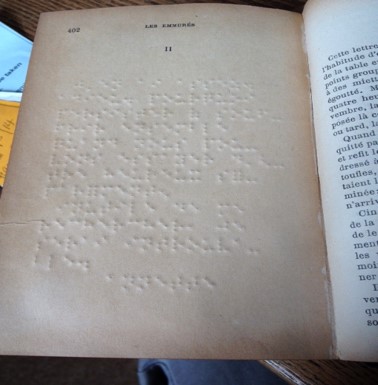
Here I am showing a picture of the page of braille
which I found bound inside the first edition.
At the climax of the novel, Savinien
returns home to an empty house. When his non-blind wife fails to return for
supper, Savinien cobbles together some leftovers and sits down to eat at his
usual place at the table. As he is eating, his wandering hand comes across a
piece of paper covered in braille. As first he ignores it, thinking it must be
some old notes he had left lying around. But then his fingers return to it and
read it more carefully: he is shocked and shaken by its contents. In the 1894
edition of the novel that I read, this crucial letter is reproduced in braille
and inserted into the novel just before Savinien’s discovery of it is
described. The placement of the letter is significant because its contents are
not revealed in the body of the text until four pages after Savinien first
reads it. So, at this crucial moment in the story only a braille reader has
access to information which is deliberately denied the non-braille reader.
Descaves’s decision to include this letter is intriguing. The rest of the novel
is in print and thus inaccessible to a blind person except via the intermediary
of a non-blind reader. A braille edition of the novel was published in the late
nineteenth century, but blind readers at the time make no reference to the
extraordinary presence of the letter – presumably because it is not noticeable
if the rest of the novel is also in braille.
Perhaps Descaves’ decision to include a braille letter in the print
edition of the novel is merely a quirky celebration of the medium of braille or
a kind of tactile illustration to give his non-blind readers a sense of what
reading braille feels like. But given the practical and financial implications
of the letter’s inclusion, as well as Descaves’ commitment to changing non-blind
people’s attitude to blindness, I think that his decision to include the letter
demonstrates his desire to undermine his non-blind readers’ dependence on, and privileging
of the sense of sight. Throughout the book, Descaves depicts blind people’s
struggles for equality and fair treatment in fascinating detail. He is
particularly interested in the opportunities provided for blind people to earn
a decent wage and to live independently and he is especially empathetic towards
those characters who fight for the rights of blind people by challenging the
assumptions of ocularcentric French society. But the non-blind reader’s own
reliance on sight – which allows us to read the book in the first place -
necessarily also contributes to, and perpetuates, the ocularcentric society
which Descaves is seeking to criticise. The non-blind reader can thus only
really understand this unfair exclusion of blind people when she experiences it
for herself by being put into an analogous situation of exclusion. Descaves
cleverly uses the braille letter as a means of purposefully withholding crucial
plot-related information from the non-braille reader. The non-blind reader is
excluded from information – because it is in a format inaccessible to her – and
thus frustrated in her attempts to make sense of Savinien’s reactions to a
letter which she cannot read. In this moment the non-blind reader understands
what it feels like to be a blind person in a society that is heavily reliant on
print as a means of communication. As well as describing the unfamiliar
experience of blindness, Descaves uses this letter to transport non-blind
readers into the world inhabited by the blind protagonists of the novel so that
they experience – albeit temporarily – what it feels like to be excluded from
an essential piece of information through no fault of their own.
This evening we have met several blind
characters who have all provided us with non-visual ways of relating to the
world. Their blindness has given us multi-sensory accounts of the world that are
not usually available to visually dependent people. We have seen how non-visual
reading is indeed an art-form. I hope that these examples of ‘blindness gain’ have
encouraged you to reconsider your own preconceived notions of vision and its
place in the hierarchy of the senses. I hope that you can think of blindness not
in terms of loss but in terms of gain.
With thanks to the eminent French researcher and doyenne of blind history, Zina Weygand, who delivered a vote of thanks after the lecture.
Wednesday, 5 September 2018
Blindness Arts: a Disability Studies Quarterly Special Issue
Co-organizing the 2015 Blind Creations conference with Vanessa Warne was one of the highlights of my academic career. As this post written in the conference's aftermath shows, the event was memorable above all for the sense of celebratory community it created. Almost as soon as the conference was over, Vanessa and I began making plans to continue the many productive conversations which started during those few summer days in Egham. We did not want or need to produce a traditional 'conference proceedings': our wonderful audio archive means that all the papers delivered at the conference are still available. Instead we wanted to extend the legacy of Blind Creations by publishing new work which responds to questions raised by our speakers in 2015. Just over three years after the conference, we are pleased and proud to announce the publication of a special issue of Disability Studies Quarterly which we have called 'Blindness Arts'. In our co-authored Introduction we explain that this title functions "in contrast with and as a companion to ‘visual arts'". This extract from later in the Introduction gives a flavour of the intersections between blindness, creativity, performance and access which the issue explores:
In the first section of our issue, we share a set of essays that explore methods for accessing cultural works. These essays take up a range of media, namely sculpture, film, theatre and the comic book, all of which have traditionally been understood as visual forms. The authors in this section challenge this overly narrow perception and share experiments with both audio description and the role of touch. As Fayen d’Evie’s and Georgina Kleege’s individual contributions to blindness studies are noted by other authors throughout our issue, it is fitting that we begin with their co-authored essay, in which they share their work on tactile interpretations of the collections at the KADIST Art Foundation, and call for new opportunities and methods for touching art. Like d’Evie and Kleege, Hannah Thompson also calls for a collaborative approach to blind access. In her essay on audio description (AD) in cinema, she engages with four films with blind protagonists in order to compare extradiegetic and intradiegetic approaches to AD and to argue for its creative potential. Louise Fryer also explores the possibilities and challenges of integrated AD by sharing her experiences as an audio describer who, in a break with traditional models of objectivity and neutrality, took an active role in a play written and performed by a blind theatre group. Arseli Dokumaci shares a video project and essay that together use an exploration of the everyday travel strategies of two disabled people to propose an AD practice shaped by crip time. The final essay in this section, Brandon Christopher’s comparative study of an audio version of a conventional comic and of Philipp Meyer’s tactile comic Life, explores audio and tactile access questions raised in other essays in this section and extends our issue’s exploration of blindness arts to include the comic book genre. Remaining attentive to questions of access, we turn in the next section to the experiences of artists and to works of art that comment on blindness, either explicitly or through their use of design elements associated with blindness. Sculptor Aaron McPeake opens this section by reflecting on the making, exhibition and reception of his works in bronze, offering insight into the role of sound and touch in experiences of them. The role of touch is also important to the art made by Florian Grond and David Johnson. In the issue’s second co-authored piece, they share their experiences as artists collaborating at a distance and they reflect on the central role of blindness in their creation of accessible art. As blind artists, both McPeake and Johnson have encountered sighted misunderstandings of their practices. In an essay that responds to the misrepresentation of blind artists and their working lives, Catalin Brylla proposes filmmaking methods that challenge supercrip narratives and make possible nuanced depictions of the creative lives of artists who are blind. In an essay on the contemporary proliferation of braille as a design element in creative works, including public art installations, made by and for sighted people, Vanessa Warne explores the appropriation of braille as a visual code. Heather Tilley offers an historical perspective on the visual depiction of blind people, analyzing nineteenth-century images of blind people reading by touch and messages about blindness that the visual record shares. A pair of essays in our final section explores different kinds of performances that have been shaped by blindness. Piet Devos analyzes two non-visual contemporary dance pieces and his experiences of them. He also discusses the practice of blind dancer Saïd Gharbi. Offering a personal reflection on her own vocal practice, Emily K. Michael moves between sacred and secular spaces to map the relationship between blindness, vocal performance and persistent myths of compensatory ability. We close the volume with a co-authored essay by Rod Michalko and Tanya Titchkosky that uses a trans-Atlantic journey and a dialogue between the authors to explore the theme of travelling blind and the ways that blindness transforms sighted understandings of the world when it enters into dialogue with them. The presence in this final essay of a series of ‘excurses’ functions as a kind of crip time, similar to the audio description method proposed by Dokumaci. In both cases, the contents of the narrative are translated into a different format so that an ableist timeframe is replaced with space for creative reflection.Unlike much academic writing, this volume is free, open access and accessible. Please read, enjoy, respond and share widely.
Wednesday, 4 July 2018
Multisensory Museums: Volunteers Wanted!
As part of a research project I am running over the summer, we are offering volunteers the chance to come and experience a truly multisensory and immersive museum or gallery visit. See below for details of two experiments you can get involved in!
1) Egham Museum

If you are interested in taking part in a multisensory exhibition of a Magnetic Electric Shock Machine, come along to the Egham Museum and participate in our free research event! Refreshments will be provided. Egham Museum will be open to volunteers on July 17th and 19th from 10am-4pm, and on July 26th from 12pm-8pm: come and open your senses to new ways of experiencing the museum. For any queries or for more information, please contact Ella Turner or Stephen Pearce.
2) Royal Holloway Picture Gallery

Come along to the Picture Gallery to participate in our research event. Everyone is welcome to experience a multisensory exhibition of the infamous ‘Man Proposes, God Disposes’. The study will take approximately 20 minutes and involves a quick questionnaire. The Picture Gallery will be open to volunteers on July 20th and 23rd from 10am-4pm. Refreshments will be provided and volunteers who have signed up in advance will receive a £10 amazon voucher. To sign-up as a volunteer or for any more information, please contact Ella Turner or Stephen Pearce.
1) Egham Museum
This is an image of a late-nineteenth-century magnetic electric shock machine such as the one used in Thomas Holloway's sanatorium at Virginia Water.*
If you are interested in taking part in a multisensory exhibition of a Magnetic Electric Shock Machine, come along to the Egham Museum and participate in our free research event! Refreshments will be provided. Egham Museum will be open to volunteers on July 17th and 19th from 10am-4pm, and on July 26th from 12pm-8pm: come and open your senses to new ways of experiencing the museum. For any queries or for more information, please contact Ella Turner or Stephen Pearce.
2) Royal Holloway Picture Gallery

This is an image of Edwin Henry Landseer's 1864 painting 'Man Proposes, God Disposes'.*
Come along to the Picture Gallery to participate in our research event. Everyone is welcome to experience a multisensory exhibition of the infamous ‘Man Proposes, God Disposes’. The study will take approximately 20 minutes and involves a quick questionnaire. The Picture Gallery will be open to volunteers on July 20th and 23rd from 10am-4pm. Refreshments will be provided and volunteers who have signed up in advance will receive a £10 amazon voucher. To sign-up as a volunteer or for any more information, please contact Ella Turner or Stephen Pearce.
*I usually provide descriptions for any images I include in blog posts: in this case I can't, as doing so might skew the results of our experiments....
Wednesday, 18 October 2017
The Man Booker Prize for (Audio) Fiction
The winner of the 2017 Man Booker Prize for Fiction is Lincoln in the Bardo by George Saunders. It is a clever, moving and deeply imaginative book and a worthy winner. But if the judges had read the shortlisted books by ear rather than by eye it would not have won.
This year I listened to all 6 shortlisted books and chose my own winner based on what I heard. I was using the same literary-merit criteria as the judges, but I added another element that sight-focused readers couldn't take into account: how the audio version of the book contributed to the reading experience.
Audio books used to be the preserve of bind people. When I was a child, they were a rare and precious thing. Now they are mainstream. Publishers routinely produce downloadable audio books alongside kindle and paper versions and a lot of (sighted) people prefer them; audible is a thriving amazon company and public libraries are finally making audio books available to download via apps like overdrive and Libby. And with popularity come production values. The audio books of my youth were little more than a voice on tape. Now publishers go to great lengths to create a memorable reading experience. They carefully choose a narrator (or narrators) whose voice matches the feel of the story. Sometimes they even add music. Yet despite the popularity of audio books, they are still not taken seriously by 'serious' (aka sighted) readers. When I tell my literature students and colleagues that I read books by ear they are skeptical. 'Audio books send me to sleep,' they say. 'How do you remember what you read?' they ask. This cynicism is insulting because it implies that blind people cannot engage with literature to the same extent as sighted people. More worryingly, it misses one of the points of prose. All the writers shortlisted for the Man Booker care deeply about how their prose sounds. The content of their book is important, but so is its form. They are all writer-poets who crafted their words for rhythm and rhyme as well as sense. Their audio books are the perfect place to experience the beauty of this prose. Yet they are still seen as less 'authemtic', less 'proper' than the printed 'original'.
Lincoln in the Bardo would not have won an audio Booker because it was almost impossible to follow by ear. Apparently the printed format of the book is 'disconcerting': this is even more the case for the audio version. So much so that I gave up listening twice before I finally got through it. According to audible, the book's 'dazzling chorus of voices' was captured by a '166-person full cast featuring award-winning actors and musicians, as well as a number of Saunders' family, friends, and members of his publishing team'. This may sound impressive in a press-release but it leads to a wholly unfeasible listening experience. Even if I were endowed with the mythical super-hearing erroneously attributed to blind people, I would not be able to recognize and attribute 166 different voices. When I listened I only got the vaguest sense of who was speaking, and I learnt more about the story from audible's synopsis than from what I actually heard. This audio book probably works brilliantly as an accompaniment to or adaptation of the printed novel. But if audio is your own way of accessing this text, then you will be frustrated and alienated by it.
The other 5 shortlisted books all make the much more sensible decision to stick with just one audio narrator. Of these, History of Wolves by Emily Fridlund and Elmet by Fiona Mozley are first-person narratives told by adolescents and both are read by audio-narrators whose voices have the age, gender and accent of their book's narrator: a young North American woman (Caitlin Thornburn) for Wolves and a young Northern English man (Gareth Bennett-Ryan) for Elmet. The fit between fictional and audio voices creates a close bond between listener and storyteller because both audio-narrators do an excellent job of capturing the tone of their protagonists. I am sure that my listening experience of these two novels was more captivating and immersive than that of my sight-reliant peers.
Ali Smith's Autumn is written in the third person, but much of the story is told from the perspective of the novel's protagonist, 32-year-old Elisabeth Demand, using free indirect style. The audio-narrator, Melody Grove, sounds close to Elisabeth in age and provenance, but she also manages to capture other key characters such as 8-year-old Elisabeth, Daniel, and Elisabeth's mother using changes in tone and inflection. Autumn works as an audio book because it has several underlying thematic threads which hold it together; it felt like the audio-narrator understands this and cleverly emphasizes them in her reading.
Exit West by Mohsin Hamid is also written in the third person but it is less successful than Autumn because it has not one but two protagonists: Nadia and Saeed. The presence of two characters of different genders makes the choice of audio-narrator difficult. If a male narrator is chosen, there is a risk that the listener feels closer to Saeed's story, whereas a female narrator will create a bond which favours Nadia's perspective. In the end, anglo-Indian actor Ashley Kumar was probably cast as audio-narrator because his voice resonates with both the novel's context and the author's persona. Despite the captivating and timely story, and the characters' powerful portrayals, I felt a distance between audio narrator and listener in this book which I did not experience in Autumn.
At 37 hours long, Paul Auster's 4321 takes about as long to listen to as the other 5 put together, and what a delight it was. 4321 is the only shortlisted book entirely narrated by its author. (Apparently George Saunders is one of Lincoln's 166 voices but I couldn't tell which one). When it is done well, as it is here, author-narration works brilliantly. No-one understands how a book should sound better than its author. I was seduced by Auster's narration of Ferguson's lives from very early on in the narrative. Not only did his voice match the main character's personas, his intimate knowledge of the text added a dimension of fluency and connection which brought another layer of emotion and understanding to the reading experience. For this reason, 4321 would be my audio Booker winner, with History of Wolves, Elmet and Autumn close behind.
As more and more people choose audio books over print versions, it seems crucial to include an audio reader among the Man Booker judges. I would happily volunteer.
This year I listened to all 6 shortlisted books and chose my own winner based on what I heard. I was using the same literary-merit criteria as the judges, but I added another element that sight-focused readers couldn't take into account: how the audio version of the book contributed to the reading experience.
Audio books used to be the preserve of bind people. When I was a child, they were a rare and precious thing. Now they are mainstream. Publishers routinely produce downloadable audio books alongside kindle and paper versions and a lot of (sighted) people prefer them; audible is a thriving amazon company and public libraries are finally making audio books available to download via apps like overdrive and Libby. And with popularity come production values. The audio books of my youth were little more than a voice on tape. Now publishers go to great lengths to create a memorable reading experience. They carefully choose a narrator (or narrators) whose voice matches the feel of the story. Sometimes they even add music. Yet despite the popularity of audio books, they are still not taken seriously by 'serious' (aka sighted) readers. When I tell my literature students and colleagues that I read books by ear they are skeptical. 'Audio books send me to sleep,' they say. 'How do you remember what you read?' they ask. This cynicism is insulting because it implies that blind people cannot engage with literature to the same extent as sighted people. More worryingly, it misses one of the points of prose. All the writers shortlisted for the Man Booker care deeply about how their prose sounds. The content of their book is important, but so is its form. They are all writer-poets who crafted their words for rhythm and rhyme as well as sense. Their audio books are the perfect place to experience the beauty of this prose. Yet they are still seen as less 'authemtic', less 'proper' than the printed 'original'.
Lincoln in the Bardo would not have won an audio Booker because it was almost impossible to follow by ear. Apparently the printed format of the book is 'disconcerting': this is even more the case for the audio version. So much so that I gave up listening twice before I finally got through it. According to audible, the book's 'dazzling chorus of voices' was captured by a '166-person full cast featuring award-winning actors and musicians, as well as a number of Saunders' family, friends, and members of his publishing team'. This may sound impressive in a press-release but it leads to a wholly unfeasible listening experience. Even if I were endowed with the mythical super-hearing erroneously attributed to blind people, I would not be able to recognize and attribute 166 different voices. When I listened I only got the vaguest sense of who was speaking, and I learnt more about the story from audible's synopsis than from what I actually heard. This audio book probably works brilliantly as an accompaniment to or adaptation of the printed novel. But if audio is your own way of accessing this text, then you will be frustrated and alienated by it.
The other 5 shortlisted books all make the much more sensible decision to stick with just one audio narrator. Of these, History of Wolves by Emily Fridlund and Elmet by Fiona Mozley are first-person narratives told by adolescents and both are read by audio-narrators whose voices have the age, gender and accent of their book's narrator: a young North American woman (Caitlin Thornburn) for Wolves and a young Northern English man (Gareth Bennett-Ryan) for Elmet. The fit between fictional and audio voices creates a close bond between listener and storyteller because both audio-narrators do an excellent job of capturing the tone of their protagonists. I am sure that my listening experience of these two novels was more captivating and immersive than that of my sight-reliant peers.
Ali Smith's Autumn is written in the third person, but much of the story is told from the perspective of the novel's protagonist, 32-year-old Elisabeth Demand, using free indirect style. The audio-narrator, Melody Grove, sounds close to Elisabeth in age and provenance, but she also manages to capture other key characters such as 8-year-old Elisabeth, Daniel, and Elisabeth's mother using changes in tone and inflection. Autumn works as an audio book because it has several underlying thematic threads which hold it together; it felt like the audio-narrator understands this and cleverly emphasizes them in her reading.
Exit West by Mohsin Hamid is also written in the third person but it is less successful than Autumn because it has not one but two protagonists: Nadia and Saeed. The presence of two characters of different genders makes the choice of audio-narrator difficult. If a male narrator is chosen, there is a risk that the listener feels closer to Saeed's story, whereas a female narrator will create a bond which favours Nadia's perspective. In the end, anglo-Indian actor Ashley Kumar was probably cast as audio-narrator because his voice resonates with both the novel's context and the author's persona. Despite the captivating and timely story, and the characters' powerful portrayals, I felt a distance between audio narrator and listener in this book which I did not experience in Autumn.
At 37 hours long, Paul Auster's 4321 takes about as long to listen to as the other 5 put together, and what a delight it was. 4321 is the only shortlisted book entirely narrated by its author. (Apparently George Saunders is one of Lincoln's 166 voices but I couldn't tell which one). When it is done well, as it is here, author-narration works brilliantly. No-one understands how a book should sound better than its author. I was seduced by Auster's narration of Ferguson's lives from very early on in the narrative. Not only did his voice match the main character's personas, his intimate knowledge of the text added a dimension of fluency and connection which brought another layer of emotion and understanding to the reading experience. For this reason, 4321 would be my audio Booker winner, with History of Wolves, Elmet and Autumn close behind.
As more and more people choose audio books over print versions, it seems crucial to include an audio reader among the Man Booker judges. I would happily volunteer.
Thursday, 7 September 2017
Reviewing Blindness in French Fiction out now!

This image shows the front cover of Reviewing Blindness in French Fiction by Hannah Thompson. Above the title, a hand is shown reading a sheet of Braille.
I am delighted to announce that my book Reviewing Blindness in French Fiction has been published by Palgrave in their Literary Disability Studies series.
In this work I show how and why French fiction is fascinated with visions of blindness by identifying and analysing the complicated relationship between writers, readers and fictions of blindness that permeates French fiction. Blindness is a mysterious phenomenon. It arouses curiosity and invites discussion. It is also a multi-layered and multi-faceted collection of narratives. Writers are drawn to blindness precisely because blindness itself is a collection of stories. The stereotypes, clichés and misconceptions which constitute what most non-blind people describe as “blindness”, have been described by David Bolt as a literary “metanarrative”. Whilst many French depictions of blindness reinforce and conform to the various strands of Bolt's mostly negative metanarrative, my work focuses on more positive depictions which question, undermine or deconstruct the prevailing myths of blindness. I re-view a selection of the most interesting, surprising and moving depictions of blindness in French fiction by authors including Brigitte Aubert, Honoré de Balzac, Georges Bataille, Tonino Benacquista, Maxime du Camp, Lucien Descaves, André Gide, Jean Giono, Hervé Guibert, Victor Hugo, Thérèse-Adèle Husson, Paul Margueritte, Guy de Maupassant, Marc Monnier, Maurice Renard, Didier Van Cauwelaert, Fred Vargas and Romain Villet.
Works by these authors contest and overturn received ideas of blindness through both the form and the content of their fiction. When blindness sheds its metaphorical meanings and exists as part of a narrative on its own terms, it becomes a positive signifier of change, desire, success and enhanced subjectivity.
Overview:
Chapter 1: Introduction
I begin my re-viewing of French fictional depictions of blindness by calling for a rejection of negative misconceptions of blindness. The most interesting depictions of blindness in French fiction are those which challenge stereotypes of blindness and the emerging field of Critical Disability Studies provides us with the theoretical tools needed to do this.
Chapter 2: The French Metanarrative of Blindness
I survey those literary depictions of blindness which reinforce the metanarrative of blindness discussed by David Bolt. Maupassant’s short story ‘The Blind Man’ evokes the blindness-ignorance and blindness-darkness synonymies whilst also using nominalisation and generalisation to dehumanise its protagonist. Blind male characters are represented as weaker, less active and less able to access language than their non-blind peers. Female blind characters, on the other hand, are often portrayed as meek and passive victims of their condition. Non-blind characters routinely trick, pity and manipulate blind characters in these typhlophobic fictions of blindness. The chapter ends with an analysis of André Gide’s The Pastorale Symphony which shows how myths of the blind mystic and of sensory compensation emphasise blind protagonists’ otherness.
Chapter 3: The Creative ‘Look’ of the Blind ‘Seer’
This chapter marks the beginning of my sustained examination of the creative possibilities of blindness. Through close-readings of novels and short stories by Honoré de Balzac, Victor Hugo, and Thérèse-Adèle Husson, I show that the unseeing gaze of the blind protagonist often transforms him or her into a surrogate narrator who is paradoxically more adept at gathering information than the sighted narrators usually present in realist texts. In works which feature blind narrators, the process of information gathering and dissemination becomes an even more overt challenge to the traditional supremacy of the sense of sight.
Chapter 4: Non-Visual Language and Descriptive Blindness
This chapter considers works by Hervé Guibert, Jean Giono, Romain Villet and Lucien Descaves which use blind characters to sensitise the reader to the descriptive power of non-visual language. In Blindsight, Guibert uses visually impenetrable language to stimulate his readers’ other senses whereas in The Song of the World, Giono mobilises the presence of a blind character to signal his use of non-visual description throughout the novel. My detailed reading of Descaves’ extraordinary novel of blindness, The Trapped, reveals not only that non-visual description is a highly effective way of communicating with a non-blind reader, but that Descaves includes braille in his novel in order to temporarily exclude his sighted readers.
Chapter 5: Male Desire and the Paradox of Blind Sexuality
In the first part of this chapter, I use readings of scenes of castration and pornographic pleasure from Hervé Guibert’s Blindsight and Georges Bataille’s Story of the Eye to suggest that both authors undermine the traditional dominance of the voyeuristic male gaze. In the second part, I explore how the non-visual eroticism suggested by the blindness-castration association is manifested in the descriptions of blind male desire found in Lucien Descaves’s The Trapped and Romain Villet’s Look.
Chapter 6: Silenced Sexualities: Listening to the Voice of the Blind Woman
Unlike the examples of blind male desire discussed in the previous chapter, the voices of blind female characters are much harder to hear. Blind female protagonists often remain silent in their texts: they are frequently unspeaking objects of the sighted male gaze and when they do speak, their words are often filtered through the voice of the male narrator. Detailed readings of Thérèse-Adèle Husson’s Reflections and Didier van Van Cauwelaert’s Jules shows how it is possible for a blind woman to subvert many of the stereotypes of blindness in order to express herself.
Chapter 7: Blind Assassins
I begin my re-viewing of French fictional depictions of blindness by calling for a rejection of negative misconceptions of blindness. The most interesting depictions of blindness in French fiction are those which challenge stereotypes of blindness and the emerging field of Critical Disability Studies provides us with the theoretical tools needed to do this.
Chapter 2: The French Metanarrative of Blindness
I survey those literary depictions of blindness which reinforce the metanarrative of blindness discussed by David Bolt. Maupassant’s short story ‘The Blind Man’ evokes the blindness-ignorance and blindness-darkness synonymies whilst also using nominalisation and generalisation to dehumanise its protagonist. Blind male characters are represented as weaker, less active and less able to access language than their non-blind peers. Female blind characters, on the other hand, are often portrayed as meek and passive victims of their condition. Non-blind characters routinely trick, pity and manipulate blind characters in these typhlophobic fictions of blindness. The chapter ends with an analysis of André Gide’s The Pastorale Symphony which shows how myths of the blind mystic and of sensory compensation emphasise blind protagonists’ otherness.
Chapter 3: The Creative ‘Look’ of the Blind ‘Seer’
This chapter marks the beginning of my sustained examination of the creative possibilities of blindness. Through close-readings of novels and short stories by Honoré de Balzac, Victor Hugo, and Thérèse-Adèle Husson, I show that the unseeing gaze of the blind protagonist often transforms him or her into a surrogate narrator who is paradoxically more adept at gathering information than the sighted narrators usually present in realist texts. In works which feature blind narrators, the process of information gathering and dissemination becomes an even more overt challenge to the traditional supremacy of the sense of sight.
Chapter 4: Non-Visual Language and Descriptive Blindness
This chapter considers works by Hervé Guibert, Jean Giono, Romain Villet and Lucien Descaves which use blind characters to sensitise the reader to the descriptive power of non-visual language. In Blindsight, Guibert uses visually impenetrable language to stimulate his readers’ other senses whereas in The Song of the World, Giono mobilises the presence of a blind character to signal his use of non-visual description throughout the novel. My detailed reading of Descaves’ extraordinary novel of blindness, The Trapped, reveals not only that non-visual description is a highly effective way of communicating with a non-blind reader, but that Descaves includes braille in his novel in order to temporarily exclude his sighted readers.
Chapter 5: Male Desire and the Paradox of Blind Sexuality
In the first part of this chapter, I use readings of scenes of castration and pornographic pleasure from Hervé Guibert’s Blindsight and Georges Bataille’s Story of the Eye to suggest that both authors undermine the traditional dominance of the voyeuristic male gaze. In the second part, I explore how the non-visual eroticism suggested by the blindness-castration association is manifested in the descriptions of blind male desire found in Lucien Descaves’s The Trapped and Romain Villet’s Look.
Chapter 6: Silenced Sexualities: Listening to the Voice of the Blind Woman
Unlike the examples of blind male desire discussed in the previous chapter, the voices of blind female characters are much harder to hear. Blind female protagonists often remain silent in their texts: they are frequently unspeaking objects of the sighted male gaze and when they do speak, their words are often filtered through the voice of the male narrator. Detailed readings of Thérèse-Adèle Husson’s Reflections and Didier van Van Cauwelaert’s Jules shows how it is possible for a blind woman to subvert many of the stereotypes of blindness in order to express herself.
Chapter 7: Blind Assassins
This is the first of two chapters to focus on a specific literary genre, in this case the roman noir. Close readings of detective fiction by Fred Vargas and Brigitte Aubert show how this traditionally ocularcentric genre can be subverted by the presence of blind characters who encourage both other characters and the reader to reconsider the assumptions they routinely make about blindness. By comparing how male and female blind detective figures relate differently to the crimes they are solving, I also show, in chapters 5 and 6, that blind men and blind women are treated differently by both friends and enemies.
Chapter 8: Science, Fantasy and (In)Visible Blindness
Science fiction’s fascination with invisibility tells us more about blindness than it does about vision. Taking Maurice Renard as my main example, my detailed readings of The Blue Peril and The Doctored Man show that rather than reinforcing the supremacy of vision in the hierarchy of the senses, narratives which present us with different ways of seeing can in fact be read as celebrations of the powers and possibilities of blindness.
Chapter 9: Conclusion
I use Tonino Benacquista’s critically acclaimed 1991 roman policier, La commedia des ratés to show how French fiction’s most interesting representations of blindness are those which draw attention to a range of stereotypes of blindness before using surprising imagery, plot twists, characterization or stylistic features to undermine the reader’s expectations. This novelistic subversion encourages the reader to look again – or re-view – his or her understanding of blindness. Blindness is best understood as a multi-faceted and multi-layered collection of narratives which, when re-viewed together, testify to the powerfully creative potential of blindness.
Chapter 9: Conclusion
I use Tonino Benacquista’s critically acclaimed 1991 roman policier, La commedia des ratés to show how French fiction’s most interesting representations of blindness are those which draw attention to a range of stereotypes of blindness before using surprising imagery, plot twists, characterization or stylistic features to undermine the reader’s expectations. This novelistic subversion encourages the reader to look again – or re-view – his or her understanding of blindness. Blindness is best understood as a multi-faceted and multi-layered collection of narratives which, when re-viewed together, testify to the powerfully creative potential of blindness.
Reviewing Blindness in French Fiction is available as a hardback or e-book from Palgrave or amazon. If you are interested in reviewing the book, please get in touch.
Subscribe to:
Posts (Atom)