Showing posts with label access. Show all posts

Wednesday, 8 February 2023

The Sensational Museum

The Sensational Museum: using what we know about disability to change how museums work for everyone.


Regular readers of this blog will know that I have a love-hate relationship with museums, especially those whose promises of disability access don't live up to the reality.... now I have a chance to share my thoughts and experiences in a more productive way...

From April 2023 I will be leading major new research project The Sensational Museum

This £1M project wants to transform access and inclusion within the museum sector by putting disability at the centre of museum practice and acknowledging the diversity and difference of all visitors. The team of academics and sector partners will work with disabled and non-disabled visitors, staff, and organizations to prototype and test a range of new ways of accessing museum collections and cataloguing objects. The 27-month long project (April 2023-July 2025) will focus on two key areas: how museums manage the objects in their collections and how the stories behind these objects are communicated to the public. At workshops and events across the UK, The Sensational Museum will develop a sense-based approach to collection and communication. This approach assumes that no specific sense is necessary or sufficient to work with or experience museum collections.

Many of my museum-based blog posts show that museums are very sight-dependent places. But many people want or need to access and process information in ways that are not only - or not entirely - visual. With this project I want to imagine a museum experience that plays to whichever senses work best for each individual visitor.

The Sensational Museum is funded by the Arts and Humanities Research Council (AHRC) and I'll be working with wonderful colleagues Anne Chick (University of Lincoln); Alison Eardley (University of Westminster); Ross Parry (University of Leicester as well as Esther Fox from Curating for Change and Matthew Cock from VocalEyes.

I'm particularly excited about the range of partners we'll be working with:

AVM Curiosities

AVM Curiosities® has been exploring the relationship between art and the senses through a series of events and interventions since 2011. Founded by award-winning artist and food historian Tasha Marks, AVM Curiosities advocates for the sensory museum, championing the use of food and fragrance as artistic mediums. Projects range from olfactory curation and scented installations to interactive lectures and limited-edition confectionery.

Barker Langham

Barker Langham is one of the world’s leading cultural consultancies, creating pioneering and sustainable projects around the globe. Across all our work, we look at questions from every angle and challenge assumptions to create unexpected, imaginative and thought-provoking outcomes.
 
Eric Langham, Founder, Barker Langham says:

“We are delighted to be part of the Sensational Museum project, and are eager to explore the prospect of redefining ‘accessibility’ not as an add-on but as an integral part of everyone’s experience. By identifying more equitable ways for all visitors to engage with museum content in a trans-sensory way, together we can begin to reimagine the museum through a new sensory logic.”

Collections Trust

Collections Trust is a small, but influential charity whose mission is to help museums work with the information that connects collections and audiences. With Art UK and the University of Leicester it is building a Museum Data Service that will pool and share object records from UK collections as the raw material for countless end uses.

Kevin Gosling, The Collections Trust says:

“While we welcome all aspects of the project, we are especially excited that it will develop an inclusive, open-access documentation interface linked to the Museum Data Service. Not before time, this will make it easier for a wider range of users to work with the information at the heart of museum practice."

Curating for Change

Curating for Change is a 3-year National Lottery Heritage funded project at Screen South. It wants to create strong career pathways for d/Deaf, disabled and neurodiverse curators in museums.

Esther Fox, Head of the Accentuate programme, lead for Curating for Change says:

“We are delighted to partner with the Sensational Museum on this exciting initiative to really examine what museums mean for audiences and staff. Our work with Curating for Change puts disabled people at the heart of leading change within museums and we are excited to support the Sensational Museum in building on this approach.”

Group for Education in Museums (GEM)
 
GEM is a membership-based sector support organisation for everyone interested in learning through museums, heritage and cultural settings. Our mission is to support and empower our community of colleagues to connect and develop their knowledge and skills to deliver learning. Our services to deliver our mission include professional membership; training and professional development opportunities; 1-1 support; annual conference and events; dedicated representatives across all four Nations of the UK; publications and digital resources, support for sector recruitment; conversations and advocacy about practice and the development of learning.

Museums Association

The Museums Association is a membership organisation representing and supporting museums and people who work with them throughout the UK. Our network includes 10,000 individual members working in all types of roles, from directors to trainees and we represent 1,500 institutional members ranging from small volunteer-run local museums to large national institutions. Founded in 1889, the MA was the world’s first professional body for museums. We lead thinking in UK museums with initiatives such as Empowering Collections and Museums Change Lives and we provide £1.4m per year of funding for museum projects via our Esmée Fairbairn Collections fund and other grants.

The Museum Platform

The Museum Platform aims to democratise how museums can make their collections - and stories about those collections - available online as cheaply, as efficiently and as easily as possible.

Mike Ellis, Founder, The Museum Platform says:

“At the heart of The Museum Platform is an aim to improve usability and access - not just for the public but also for time-pressed museum staff who need to maintain this content. We’re therefore delighted to be involved in The Sensational Museum, and are excited about getting deeply involved in the project with you and with all project partners over the coming months.”

Scottish Museums Federation

The Scottish Museums Federation is a membership body for anyone interested in the Scottish museums and galleries sector. We provide our members with networking opportunities, a dynamic forum to share information and discuss current issues in the sector, and encourage creativity, enjoyment and personal development in the sector.

Quonya Huff, President of the Scottish Museums Federation says:

“We're excited to be part of this pioneering project and even more so that it will bring tangible training to the Scottish museum and galleries sector.”

VocalEyes

We believe that blind and visually impaired people should have the best possible opportunities to experience and enjoy art and heritage. Our mission is to increase those opportunities, make them as good as possible, and ensure that as many blind and visually impaired people as possible are aware of them, and that the arts and heritage sector know how to create them, and welcome blind people as a core audience.

Matthew Cock, Chief Executive, VocalEyes says:

We’re thrilled to be involved in The Sensational Museum, which promises to be a ground-breaking project for the museum and heritage sector, turning traditional practice on its head and placing the experiences of disabled people at the heart of the process. VocalEyes’ role will be as Sector Impact Lead, helping to disseminate the project’s research findings to people working within museums and heritage sector organisations, raising awareness of the findings, resources and toolkits, and influencing and bringing about change to practice.


Wellcome Collection

Wellcome Collection is a free museum exploring health and human experience. Its mission is to challenge how we all think and feel about health by connecting science, medicine, life and art. It offers a changing programme of curated exhibitions, museum and library collections, public events, in addition to a café. Wellcome Collection publishes books on what it means to be human, and collaborates widely to reach broad and diverse audiences, locally and globally. Wellcome Collection actively develops and preserves collections for current and future audiences and, where possible, offers new narratives about health and the human condition. Wellcome Collection works to engage underrepresented audiences, including D/deaf, disabled, neurodivergent, and racially minoritised communities.

Georgia Monk, Senior Project Manager, Exhibitions, Wellcome Collection says:

"Wellcome Collection has been in the process of developing its approach to inclusive and accessible exhibition making for several years and this is the perfect moment for us to engage with the Sensational Museum project and learn collaboratively with this extraordinary group of peers and partners."


This is an image of the logos of all the university and heritage sector partners involved in the Sensational Museum

Sunday, 10 April 2022

The Louvre: A Museum Accessible to All?


[This image shows the apparently now defunct Tactile Gallery at the Louvre. On a sign in the left of the image we read ‘Galerie d’étude I : espace adaptée aux visiteurs non et malvoyants’ {Study Gallery I: space adapted for blind and visually impaired visitors'). Next to this sign is a bare room closed off by a metal gate. The room has stone walls and tiny windows. It seems to be bathed in creamy yellow light. It is completely empty. It looks like a designer prison cell.]

** UPDATE: 13/04/22 ** The Louvre got in touch the day after I published my post. They apologized for the current situation, thanked me for my feedback and have promised to work on better communication of their offerings to all concerned. They gave me a link to the audio-described tour of the current exhibition and reassured me that the Tactile Gallery has not gone for good, but is being renovated.

I am used to being disappointed by museums' accessibility offerings. (Examples here and here). But I was not expecting to have my worst experience at one of the world's most famous museums. According to their website, the Louvre is "accessible à tous" (accessible to everyone). I was especially looking forward to visiting the Petite Galerie which has a very promising description on the museum website:

The Petite Galerie is a dedicated space for disabled visitors. Entirely accessible, it is equipped with tactile ground surface indicators. A braille booklet is lent free of charge and a downloadable guided tour with audio descriptions is available on the Petite Galerie app.

La Petite Galerie est un lieu d’accueil privilégié pour les visiteurs en situation de handicap. Entièrement accessible, l'espace propose des dispositifs adaptés : bande de guidage podotactile, prêt gratuit d’un livret tactile remis, parcours audio-décrit téléchargeable sur l’application "La Petite Galerie".

After feeling frustrated by the general lack of access for blind people elsewhere in the Louvre, I was expecting great things from the Petite Galerie. I'm not a fan of 'special' rooms for disabled visitors, but some provision, even if marginalized, is better than none. 

When we arrived, we found that the Petite Galerie does indeed have an audio described tour of a handful of items in the 'Figures d'artiste' exhibition on their app. Sadly, this exhibition closed last year: the current exhibition is not audio-described and the app has not been updated. To add insult to injury, the out-of-date audio is still on the app. Massive disappointment. The gallery attendants had no idea why this year's exhibition has not been described. They did, however offer me a tactile booklet that accompanies the current exhibition, 'Venus d'ailleurs: materiaux et objets de voyage' (From Afar: Travelling Materials and Objects).

Given that the 'Petite Galerie' is specifically designed for disabled visitors, I was pretty shocked and upset that I couldn't access audio descriptions of any of the 50 of so exhibits. But my friend and I decided to try the tactile booklet anyway. Here is what we found:

The booklet contains 2D relief drawings of 7 works; 6 objects and 1 painting. There is also a tactile plan of the exhibition which was supposed to help us locate the objects. The first two rooms in the exhibition have 'guidage podotactile' (raised floor markings) that are also shown on the tactile map. (Oddly the raised markings stop at the entrance to the third and final room: blind people are not welcome there). The AD of the previous exhibition explains how to find each object. Without it, we found it hard to locate the objects, especially because, as my friend pointed out, some of them are extremely small.

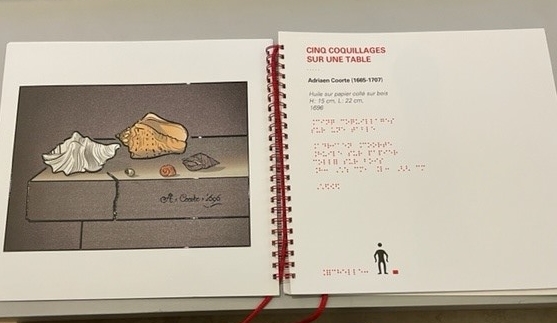
The tactile reproduction of the painting apparently does quite a good job of capturing the shapes and textures of the five shells:

An oil painting of 5 shells in an ornate frame


[The top image shows an oil painting of 5 shells in an ornate frame; the lower image shows the tactile reproduction of the painting on the left-hand page of the tactile booklet; printed and braille information about the painting is on the right-hand page.]

In fact, my friend thought that non-blind visitors would appreciate the details given by the tactile drawing, which are not necessarily visible in the painting. This is great if you care about the shells themselves, but less great if you want a tactile experience equivalent to how a non-blind person might look at the painting. Reproducing details that a non-blind person can't see, gives a skewed idea of how the painting looks. 

The booklet gives basic information (title, artist, materials, dates, dimensions) in French in grade 1 (uncontracted) Braille and slightly larger than standard print. But there is no explanation of what the painting looks like, why it is significant or how it fits into the exhibition as a whole. Even more frustratingly, the exhibition's information panels and curator notes are not translated into Braille but are only available as wall panels in very small type. The tactile booklet gave me no sense of the exhibition as a whole.

Things got even worse when we compared the tactile reproductions of the 6 objects with the artefacts on display. Creating tactile drawings is tricky: you need to provide enough information to make the object recognisable, but too much information can be confusing, especially if not accompanied by an audio explanation. Unfortunately, the Louvre has decided that it is best to provide minimal information: this results in insultingly simplistic representations that feel more like children's' book illustrations than representations of historic artefacts. Compare the tiny elephant figure pictured below with its tactile representation and you will understand what I mean: 


[The top image shows a tiny bronze elephant statue. I have no idea what it was used for or where it is from. It is standing on a wedge-shaped platform so that it is at an angle with its front feet slightly higher than its back feet. It is in a display case with a mirrored back in which my face and phone are reflected. The second image shows a basic elephant shape in relief on the left-hand page of the tactile booklet. The right-hand page contains minimal information in print and braille.]

Nothing in the tactile booklet tells me how the elephant actually feels, and I have to use my own understanding of the one measurement provided (h: 9cm) to work out how the scale of the reproduction relates to the original. More worryingly, there is no acknowledgement that the practice of transforming 3D objects into 2D tactile representations is deeply flawed. Nothing in the reproduction gives a sense of the actual elephant. What we have here, at best, is a generic picture of an elephant: I am pretty sure that most blind people are familiar with the concept of an elephant. At worst we have an incredibly infantilising and insulting tactile drawing that tells us nothing about the artefact or its place in the exhibition. (Here is not the place to get into the dangerously Orientalist decision to use an elephant to represent the exotic other.....). 

The tactile reproductions of the other objects were not much better. The elephant obsession continued with an 'olifant' (horn) made out of ivory. 


[The top image shows an 'olifant' hanging in a display case. There is a reflection of me in the background. The horn seems to have intricate markings carved into it. The lower image shows a double-page in the tactile guide. On the left, a tactile drawing of the horn. Two areas of the horn are outlined in red; enlarged reproductions of them are included below the drawing of the horn. On the right, minimal details about the horn are included in print and braille.]

This time there was an effort to include some of the details on the horn in separate drawings of specific elements. My friend noticed an explanatory panel next to the horn. It gives several sentences of interpretation in English and French as well as a map illustrating the object's provenance. The text on the panel is too small for me to read. None of it is included in the tactile booklet.


[This image shows a display panel next to the horn. The text is in French and English. It is printed too small for me to read (perhaps 10 or 12 point). There is also a line-drawn map with a shaded area indicating where the object is from. I can see enough to guess it is Middle-Eastern.]

Almost all the objects in the exhibition are in Perspex display cases. But there was one object - another ivory horn - that was displayed without a case. I was enjoying touching it until my friend noticed what we thought might be a 'do not touch' symbol next to it. (The irony that I could not see the sign did not escape us).


[This image shows a larger elephant tusk or horn. It is not in a case and is invitingly at hand level. Below the object there is a short explanatory text. There is also a panel with two images: both crossed out by a red diagonal line: one is a hand with an extended finger; the other is a speaker with sound waves coming out of it and 'durée 8 minutes' written next to it: can this mean that there used to be an 8-minute AD for this object that is no longer available?]

To be fair, the gallery staff were pretty embarrassed and appalled by my experience. They are under-paid and over-worked and none of this is their fault. They suggested that we report the situation to the visitor experience team. They also recommended going to explore the Louvre's famous Tactile Gallery, one of the first tactile sculpture galleries in Europe.

On the recommendation of the gallery staff, we did go and talk to visitor services about the Louvre's offer for blind and partially blind people. When I explained that the Petite Galerie app no longer includes AD, they suggested that we avail ourselves of the 'standard' audio guide instead. However, further questions revealed the limitations of this standard audio guide for blind visitors. No, there aren't any audio descriptions of works included in the standard guide. Yes, there is explanatory, contextual and interpretative material only. Yes, you have to be able to read a number placed next to each work and enter it into a touch tablet. No, this system isn't accessible to non-accompanied blind people. No, there are no tactile handsets or braille or large-print transcripts. No, the objects in the Petite Galerie are not included in the 'standard' audio guide. Yes, it probably is true that the museum is not accessible to blind people.

Our final stop was the famous Tactile Gallery. The Gallery opened in 1995 and soon became a flagship gallery for museum accessibility. When I asked my not-so-helpful visitor services helper for directions, I was stunned by his response: "Ah, Madame, ça n'existe plus!" (Oh, Madam, that no longer exists). nfortunately the attendants in the Petite Galerie did not know that the Tactile Gallery had been shut down. This is not just a temporary Covid Closure. As the image at the top of the page, and these two images, show, the Tactile Gallery has apparently gone for good:


[The top image shows a sign reading ‘Galerie d’étude I: espace adaptée aux visiteurs non et malvoyants’ {Study Gallery I: space adapted for blind and visually impaired visitors'). The lower image shows an empty room closed off by a metal gate. The room has stone walls and tiny windows. It seems to be bathed in creamy yellow light. It is completely empty. It looks like a designer prison cell.]

No-one in the museum could tell me why the Tactile Gallery has been abolished. If I were being charitable I would guess that it has been abandoned because it will become redundant once the Louvre makes every object properly accessible to all. Until that day comes, here is my advice for the Louvre:

Remember that 'access' does not just mean physical access to a space. It also means giving people information and experiences in ways that work for them. There is no point offering to meet me at a bus stop and guide me into the Louvre if I then can't access any of the art once I am inside your 'accessible' building. 

Be honest: if there is no longer audio description, update your app and your website so that I don't waste my time and money. Your website promises something you don't deliver; you raised my expectations and that made my disappointment and frustration worse. It is rare that museums make me cry but you very nearly managed it.

Rethink your priorities. You are one of the most famous museums in the world. Don't you think that everyone should have access to your collections? Surely you could invest some of the profit you make from entrance fees, and shop and café mark-ups into proper permanent access? How about leading by example?

Celebrate access: as I have shown elsewhere, creative audio description benefits all visitors. Instead of marginalizing disabled visitors make us the centre of your offering. No non-disabled visitor is ever going to say 'I hate this museum, it is too accessible'.

Don't hide behind excuses around logistics / finance / admin / aesthetics: if small museums like the Royal Holloway Picture Gallery or the Guildhall Museum can make their collections accessible, so can you.

Involve disabled people in curation and exhibition design: even highly qualified non-blind people are not as good at designing accessible exhibits as the people who use them.

Saturday, 30 October 2021

The Spanish Gallery in Bishop Auckland: a land of missed opportunities


The Spanish Gallery is “the UK’s first gallery dedicated to the art, history, and culture of Spain”. It opened on 15 October 2021 in the small market town of Bishop Auckland, County Durham, and is part of the ambitious Auckland Project regeneration scheme.

On arrival, I was immediately impressed by the ramps, automatic doors, and spacious lifts. A wheelchair access audit had clearly been part of the museum’s design and wheelchair drivers were very well catered for. However, when I asked about large print, braille, and audio guides I was met with a baffled silence. “I don’t know about anything like that” said one staff member, “but there are volunteers in every room who will read things out to you if you ask them.” A well-meant offer, but the equivalent, for me, of a wheelchair user being told: “We don’t have ramps, but our volunteers will carry you up the stairs if you ask them.” I didn’t even bother asking about more creative access initiatives such as the provision of torches and magnifying glasses or live or recorded audio description.

Despite my all too familiar feelings of frustration, I made my way through the automatic doors into the first of several galleries. The paintings and some of the explanations were lit with spotlights and the rest of the space was in semi-darkness. It was impossible for me to read the small labels next to each picture, so I soon gave up even trying, and focused on attempting to read the larger explanatory text at the entrance to each room. Unfortunately, the design team had prioritized the overall look of the galleries over their accessibility. Whilst some wall-mounted text had reasonably good contrast, I’d say about half of the explanations did not meet Web Content Accessibility Guidelines (WCAG). WCAG is the international standard for the accessibility of web content and can also be used as a helpful guide to making non-web content such as signs, notices, menus and gallery labels readable. (If you want to know how accessible your colour contrasts are, consult the brilliant Who Can Use tool to find out.)

Things got slightly better on the top floor. I was particularly interested in the wall-mounted copies of plaster casts originally made in the early twentieth century “by unnamed craftsmen documenting the sculptural heritage of Spain.”


The image shows wall-mounted 3-D printed copies of early 20th century plaster-casts, themselves copies of the Virtues of Prudence, Courage and Temperance from the Sepulchre of Cardinal Tavera (1553)

The 3 statues are “factum facsimilies […] made from white light scanned data merged with high-resolution photogrammetry. They were 3D printed using SLA, moulded and cast in an acrylic resin.” They are part of the FactumFoundation project to produce a 3-D model of the 1553 Sepulchre. You can read more about the project on the Factum Foundation website. Apparently, it was Henry Cole, the first director of London’s Victoria and Albert Museum, who initially championed the creation and display of recreations of works of art. For him it was a way of making “works of art freely available everywhere and to everyone.” Sadly, I was not allowed to touch the statues or the sepulchre. Ironically, the museum’s celebration of Cole’s vision of “shared cultural access” does not extend to non-sighted people. Even though many museums are using 3-D printing to make objects accessible to blind people, the objects in the Spanish Gallery have now become off-limits despite their reproducibility. The museum’s labelling tells me that “Access can take many forms from screens to headsets, glasses, hybrid mixes, but it can also be physical.” Indeed. Another missed opportunity.

As I was leaving the facsimile gallery, I overheard one staff member telling another about the QR codes that are included on a few of the gallery’s labels. My ears pricked up and with the help of my companions I located and scanned one.


The image shows a small gallery label accompanied by a QR code.

 I was taken to a web page with a longer – and crucially – zoomable – version of the gallery label. If only someone had thought to tell me about these QR codes at the beginning of my visit. 


This image shows my phone screen with the museum label enlarged thanks to the QR code. Presumably this webpage would also be accessible to Voice Over users.

Although not as good as an accessible app like Smartify (used down the road in the Bowes Museum), QR codes do make the gallery content more accessible to smart phone users. Despite watching me navigate the galleries with my white cane, no-one told me about the gallery’s only accessible feature.

I don’t know how much the Spanish Gallery cost. But I do know that its owners have created a land of missed opportunities. Accessibility was not built into the gallery's design and will now be hugely expensive and inconvenient to add. Staff are not briefed about how QR codes can function as an accessible feature. And the gallery has invested in 3-D replicas of sculptures that we are not allowed to touch. 

Tuesday, 16 June 2020

Audio Description at Royal Holloway


Image Description: The painting 'Man Proposes, God Disposes' by Sir Edwin Landseer hangs in its lavish golden frame among other paintings on a rich red wall in Royal Holloway's Picture Gallery. Read on for a link to a creative audio description of the picture.

Those of you who have been following Blind Spot Blog for a while will remember the 2015 Blind Creations conference and micro arts festival held at Royal Holloway, and organised by myself and Vanessa Warne (University of Manitoba). One of the highlights of the conference was a live audio-described tour of some of the paintings displayed in Royal Holloway's famous Picture Gallery

Since the success of Vanessa's audio descriptions at Blind Creations, I have been working with the College Curator, Laura MacCulloch to explore innovative ways of making the College’s Art Collections accessible to a wider public. I have also been researching and writing about creative audio description and talking to a lot of people about my theory of ‘blindness gain’. Laura has been working hard to secure some funding to make the Picture Gallery more accessible and has been using the museum and gallery app Smartify to create virtual information panels for all the gallery's pictures. 

Earlier this year, Laura was able to employ an audio-description intern to help us run a crowd-sourced audio description project. We invited volunteers from across the College community (including students, staff and alumnae) to produce their own creative audio description of paintings in the Picture Gallery. Unlike traditional audio description, creative audio description (CAD) does not claim to offer an objective description of an image. Instead it recognizes that each beholder will see things differently. It welcomes non-normative gazes and encourages individual and inventive responses to art. It celebrates diversity of interpretation and asks people to produce a subjective response using whatever words speak to them personally. These creative audio descriptions give both blind and sighted visitors a new way of experiencing art. They highlight the describer's responses to each painting's aesthetic and emotional aspects as well as to its visual appearance and place in the gallery. They are an excellent example of 'blindness gain'.

Our project has been put on hold during the Covid-19 pandemic, but Laura and assistant curator Michaela Jones have used Smartify to create a free online audio-described tour of a selection of paintings from the Picture Gallery. Thanks to this tour, these paintings are now accessible to blind people around the world. You will hear a short introduction by me followed by creative audio descriptions of 15 paintings from the Picture Gallery, including famous works such as ‘Man Disposes, God Proposes’ and ‘Princess Elizabeth in Prison at St James’’ alongside some lesser-known gems. Some of these are located high on the Picture Gallery’s walls and are not usually spotted by visitors to the gallery. 14 of the descriptions are by current students and staff and we have also included one of the original recordings from Blind Creations, where the project originated.

As well as improving access to the Picture Gallery and adding to the range of online gallery tours available for free during lockdown, this project has also enhanced student employability through the creation of internships; strengthened links between different parts of the college community; and created a set of creative audio descriptions which I will be able to use as my research into the benefits of creative audio description for everyone develops. 

Special thanks go to Laura MacCulloch, Michaela Jones, Emma Hughes and all the staff and students who volunteered to be part of the project. 


Monday, 19 November 2018

3rd International CAFE Conference, Bilbao


This image shows myself and fellow panel members Lyubomyr Pokotylo (CAFE Audio Description Commentary Network) and Julian Ronca (AD Commentator, Olympic Marseille) listening to Alan March deliver a live AD Commentary. Examples of Alan March's ADC can be found here.)

This week-end I was delighted to be invited to speak on audio description commentary at the third international CAFE conference at the Estadio San Mamès in Bilbao. CAFE (Centre for Access to Football in Europe) is a pan-European organisation supported by FIFA and UEFA. It aims to promote equal access to football for all and has been successful in implementing improved access features at recent European and World football tournaments. 

During my session, I was especially pleased to hear from Alan March, who is a hugely experienced audio description commentator. and expert member of the CAFE Audio Description Commentary Network and Training Programme. During his talk, Alan used a comparison between TV, radio and AD commentary of the same goal to reveal just how crucial properly delivered AD is to blind and partially blind football fans. Unlike the TV and radio commentary we are used to hearing, good ADC should enable anyone - whether they are blind or non-blind - to understand what is happening on the pitch (and off it) as it happens. We saw in Alan's examples that TV and radio commentary is often just that - it comments on the action without describing it, and thus relies on the listening public also having visual access to what is happening. That this assumption of visual access routinely happens in mainstream radio commentary is beyond disappointing. As I know from my own experience at the 2016 Euros in Toulouse, good audio description can transform the match-day experience. If I can imagine the movement of the ball I feel immersed in the action of the game. But if all I have is general reflection on the players' performance, I feel completely isolated from the fans around me. As Alan's demonstration showed, AD commentary is very different to the kind of AD found in the cinema (and which I discuss here, here and here). ADC is as unpredictable and spontaneous as the game itself. It takes effort, commitment and energy to deliver a successful ADC. Like the simultaneous interpreters who translated our panel into French, German, Spanish, Polish and Russian, AD commentators are performing a hugely difficult and skillful task of immediate translation. Whilst certain elements can be prepared in advance, such as the lists of players and descriptions of the stadium architecture, the bulk of the ADC has to be delivered spontaneously.  It is a thrilling addition to any game and is an example of what I call  'blindness gain' because it has the potential to add value to every spectator's experience. Like the audio book, ADC deserves to be taken much more seriously. It should be offered as a matter of course at all live sporting events and professional standards of training and accreditation should be developed to reward and recognize those who deliver it so well.

CAFE is passionate about all kinds of access. At the conference we also heard from football's governing bodies FIFA and UEFA about their access initiatives and there seemed to be a genuine commitment to make sure that major tournaments are accessible to all. Perhaps more importantly, we also heard from disabled fans about how better access has radically improved their experience. I was particularly struck by the testimony of Stephen and Morgan Parry who explained why it is crucial that all stadiums include Changing Places rooms so that non-ambulant disabled adults can access toilet facilities.

I was also interested in the conference for other reasons. This year I have been responsible for developing and delivering a new Translation Studies degree programme at Royal Holloway. With my linguist's hat on, I was fascinated to see the work of the simultaneous interpreters during the conference and frequently switched between English, French and Spanish channels on my headset to compare their translations. When the first of many videos was projected during the conference I also searched in vain for the audio description channel. Given that the tech was already in place for comprehensive simultaneous translation, it would have been very simple to include an audio description in the access provision. Indeed, if we think of AD as a translation service rather than (or as well as) an access service, all multi-lingual conferences might be more inclined to include it as a matter of course. I'm looking forward to seeing this put in place for the next CAFE conference in 2021 which I very much hope to attend. 


Thursday, 22 June 2017

The Braille Legacy: the irony of (lack of) access

When I heard that a French musical about the life of Louis Braille was opening in London my heart sank. How, I wondered, could the production possibly avoid the stereotypes of blindness in a genre which thrives on cliche-ridden songs of sentimental pity or triumphant overcoming? Luke-warm reviews of the show confirmed my fears, as did the director's controversial decision not to cast a single blind or partially-blind actor. Disability activist MIchele Taylor criticised the show for its 'spectacular cripping-up' of blindness as well as for its failure to employ any blind cast or crew: she boycotted the show for these reasons. Despite not being able to attend an AD performance - out of 90 performances, only 2 were audio described and they were both on the same bank holiday weekend when I was out of town - my curiosity got the better of me...

...and on one level it was rather better than I was expecting. An outstanding performance by Jack Wolfe as turbulent, intelligent (and actually quite sexy) bad-boy Braille and some pretty good tunes led to an enthralling and moving evening: on the whole the play did a very good job of telling an important and little-known story. But there were also some serious problems....

From Vocaleye's helpful introduction to the play I learnt about the over-complicated glass and wood two-storey set, the unnecessarily detailed period costumes and the fact that all the blind characters in the play wear blindfolds to symbolize their blindness. 

Wait. Blindfolds? Really? 
Yep. Blindfolds. 

In their introduction, the describers explain that 'All the actors in the production are sighted.  Blindness is indicated by gauzy black cloths worn as blindfolds.'

This use of blindfolds to represent physical blindness is problematic for many reasons. Firstly, it suggests that blindness is these children's only defining characteristic; their blindfolds stigmatize them, positing them as a homogeneous and marginal group who are diametrically opposed to their sighted teachers and carers. Secondly, it suggests - wrongly - that blindness is always total and always in both eyes. This use of blindfolds reminds me of the controversial use of blindness simulations to allegedly teach sighted people about blindness. Researchers have recently found that simulating blindness can in fact do more harm than good, and I fear that the show's use of blindfolds may have a similar effect. 

But as the play progresses, the blind children sometimes remove their blindfolds, particularly when they are celebrating the invention of the braille alphabet or protesting against the Institute's refusal to let them use braille to read. This removal suggests that the blindfolds do not in fact signify physical blindness at all. Instead they stand for the metaphorical blindness which comes from being denied access to literature and knowledge. This association between blindness and lack of knowledge is of course equally problematic. As David Bolt explains in The Metanarrative of Blindness, the ‘seeing-knowing metaphor’ (p. 18), like the ‘blindness-darkness synonymy’ (p. 21) and the odd idea that people are either fully blind or fully sighted (pp. 69-70) all contribute to sighted society's view that blindness is an affliction in need of a cure or a tragedy in need of a happy-ending. But at least this metaphorical dimension allows the director to make the point that the children are 'blinded' less by their physical lack of sight than by society's insistence on using sighted means to communicate information. 

Importantly, as well as telling the story of the invention of braille, the plot of The Braille Legacy includes a sinister suggestion that an over-zealous ophthalmologist at the Institute was secretly conducting dangerous, even fatal, experiments on the children's eyes in a bid to find a 'cure' for blindness. Happily, this medicalization of blindness is countered by the play's more sympathetic characters who argue that blind children do not want or need a cure: instead all they need is a simple and universal way of accessing information. This tension between cure and societal change echoes the tension between the 'medical' and 'social' models of disability which still exists today. By associating the cure with the death of innocent children, the play controversially argues against medical intervention and in favour of improved access to literature, culture and the arts. 

Given this insistence that the blind children deserve access to knowledge, it is unspeakably ironic that the play itself was not made accessible to blind audience members. If audio-described performances are too expensive then why not include AD in the show itself? Surely this production would have been ideally suited to the kinds of integrated audio description deployed so effectively by theatre company ExtantWhy not use a simple set rather than a confusing structure with reflective surfaces and glaring spot lights? Things off-stage were no better. Despite the fact that the production was supported by the RNIB, I saw no evidence of braille or large-print programmes. This is a shocking omission as is the fact that the video about the play on the RNIB website is captioned but not audio described. If the RNIB can't lead by example then how can other organisations hope to improve access? To be fair, the front-of-house staff had clearly had some training in how to act as sighted guides, but their techniques, whilst enthusiastic, were clumsy and patronizing in places. Perhaps the play's overall lack of accessibility meant that they did not have many blind audience members to practice on...

Overall, this production represents a massive missed opportunity: whilst the play's script convincingly calls for the emancipation of blind people, this optimistic message is completely undermined by the failure to make the production accessible. Like the embossed books which frustrate Louis in the opening scene, the play was designed by sighted people who have put no thought into the best way for blind people to access its content.


Saturday, 11 March 2017

Audio Description in the Art Gallery 2

As part of some scoping work for my new research project on creative and collaborative audio description, I have been experiencing AD in various settings. Last week I went to a high-profile (and expensive) exhibition at an internationally renowned university museum whose AD provision was rather limited. Yesterday I went to a small exhibition at the Guildhall Museum in Rochester (Kent) who have adopted a much more inclusive, and impressive, approach.


This photograph shows a poster advertising 'The Value of Touch'

'The Value of Touch' is an exhibition of work by members of the Kent Association for the Blind Medway Art Group curated and facilitated by artist Wendy Daws, whose new touchable art works also feature in the exhibition. Yesterday's tour was particularly remarkable for the layers of interconnected and collaborative audio and tactile experience it revealed and encouraged. At the beginning of the project, in July 2016, the artists were given an audio and tactile tour of objects in the Guildhall Museum's collections by the collections manager Steve Nye. They then worked with Wendy to create tactile art works inspired by the museum's artifacts. Not only was art created in response to tactile and audio experience, it also had tactility embedded within it. This meant that yesterday's audio described tour, delivered by Lonny Evans from VocalEyes, could easily incorporate a tactile element because all the art works were designed to be touched as well as looked at. In addition, Wendy added her own touchable art works to the show.

This photograph shows Wendy's artistic responses to the artists' work. Lonny's audio description says: "'Low Relief Tactile Representations' captures in tactile form the key artworks from the exhibition. A significant motif from each of the artists' work has been selected and rendered in 11 separate crystacal plaster plaques moulded from carved clay. The raised plaques are creamy white and about the size of a large side plate. They are embedded in two rows into a purpose built grey table." What Lonny doesn't say is that beneath the artworks is a sign, in print and braille, which says 'Please touch gently'.
These artistic responses to the artists' responses to the museum's objects create a third layer of tactile experience which visitors can explore alongside the artworks. Lonny's description adds an audio layer. When experienced together these four elements represent both an artistic response and a tactile-audio translation; a brilliant example of how access can be literally built into art and how art can be inspired by access as well as being mediated through it.

After describing the general layout of the exhibition spaces, Lonny gave us an audio account of a selection of the artworks on display before letting us touch both the artworks themselves and some of the artifacts which inspired them. Lonny also included quotations from the artists and those artists who were present also spoke about their own works. The result was an immersive, collaborate and inclusive audio and tactile experience which enabled visitors to experience art in a multi-sensory way.

As well as writing and delivering the AD script, Lonny has agreed to make it available online so that anyone can use it as part of their gallery experience. This means that blind (and sighted!) people can get a sense of the exhibition before, during or after their visit. The museum has also produced large print and braille guides to accompany the exhibition.

When I asked the Ashmolean why they had not produced large print, braille or audio guides for their Degas to Picasso exhibition, they said that it is generally not worth producing such materials for a temporary exhibition. But yesterday's audio tour at the Guildhall Museum''s temporary exhibition gave 20 blind and partially blind people an unforgettable and immersive experience. It is also now available to anyone who wants it. This exhibition is a model of best practice which other museums and galleries should be encouraged to emulate. This is because access is celebrated here for its creative and collaborative potential. It is positioned at the centre of this exhibition, not added (or more often than not omitted) as a costly and cumbersome afterthought.


Thursday, 28 January 2016

Making Space for Accessible Art

Yesterday I was delighted to welcome Blind Creations artist David Johnson back to Royal Holloway. David’s large-scale outdoor installation ‘Too Big to Feel’, which was commissioned for the Blind Creations conference held at Royal Holloway in June 2015, is now part of the College’s Art Collections.


This picture shows 'Too Big to Feel' by David Johnson on the grassy slope below the hockey pitch. The piece is made up of 18 concrete domes, 17 of which are painted white, and 1 of which is red. They look like giant Braille dots and spell out 'Seeing Red' in grade 2 (contracted) Braille. 

Yesterday David presented his work in the context of the College’s ‘Making Space for Art’ lecture series.


This picture shows David during his talk. He is standing in front of a screen on which we are shown an image of 'Too Big to Feel' in its first location in front of the Founder's Building. (Photo by Ruth Hemus)

I particularly like the way that ‘Too Big to Feel’ celebrates the creative potential of Braille whilst at the same time raising questions about the opacity of language and its meanings more generally. By making Braille both the subject and the medium of his work, David invites non-blind people to engage imaginatively with the techniques blind people use to read and write. Rather than being the reserve of a few, Braille becomes visible to, and touchable by, everyone. Blindness’s creative potential is thus celebrated and assistive technologies are consequently transformed into exciting and innovative ways of questioning our relationship with language and the senses.


This picture shows another of David’s Braille creations,  ‘Eggs’. Three casts of egg boxes sit on a table. Inside each nestle concrete eggs. The eggs are arranged to spell out 'egg' in grade 2 Braille. (Photo by Ruth Hemus)

David uses the screen-reading software JAWS to access his computer. By hooking his laptop up to the seminar room’s projector, we were able to see images of David’s works whilst at the same time hearing the computer’s audio prompts to him. This had the unintended consequence of demonstrating to non-blind members of the audience how screen reading technology works whilst simultaneously revealing its artistic potential. As he does with Braille, David uses JAWS in his artistic creations. His work ‘Rosie One’ is an audio installation in which the screen-reader’s response to a word document reveals both the arbitrary nature of language and the human brain’s ability to jump between two different interpretations of the same sounds.

You can listen to the whole of David's talk, including 'Rosie One' by clicking here.

As well as using various kinds of assistive technology in his work, David also works with friends and assistants in the creation of his art works.  David’s blindness means that there are times when he has to trust other people to make choices for him, particularly when he wants to include colour in his work.


This picture shows 'Citrus Corners': several black triangles, which have been made from casts of the inside of plastic bags, sit on a black perspex square on a table. The tips of these 'corners' have been painted yellow. David explained the process of communication involved when his assistant helps him decide which shade of yellow to use. (Photo by Ruth Hemus)

David’s collaborative art practices challenge the received notions that dependency on others is a sign of weakness, and that disabled people should strive for independence. During his talk, David asked each member to the audience to create a human figure out of plasticine.  At the end of the talk, he asked us to place these figures in a circle, facing inwards. The resulting artwork was a celebration of collaboration: on their own each figure meant nothing, but together they stood for the creative power of the group.


This picture shows the finished collaborate artwork. Fifteen green plasticine figures of various shapes and sizes stand or sit on a table. They are in a large circle and are all facing inwards, towards each other. (Photo by Ruth Hemus)

I am delighted that as a result of Blind Creations, my collaboration with David will continue. In February we travel to Boston to take part in a panel at the 2016 Transcultural Exchange Conference and David has also secured Arts Council funding to visit Art beyond Sight in New York and to present a pop-up exhibition in Montreal. We also hope to invite him back to campus later in the year to run more collaborative art-making workshops with our students.


Tuesday, 6 October 2015

Exploring Human Rights in Winnipeg

I spent last week in Winnipeg, Canada where my tireless Blind Creations collaborator Vanessa Warne had arranged for me to give lectures and teach classes at the University of Manitoba and the Université de Saint-Boniface. I also enjoyed sharing experiences and insights with the Manitoba Disability Studies Network before exploring Vanessa's fascinating 'Books without Ink' exhibition.

On my last day, Vanessa gave me a tour of the Canadian Museum for Human Rights which has recently opened in Winnipeg. We had passed the imposing building several times during the week and I was eager to look inside.


This photo (taken by Vanessa) shows me 
standing outside the Canadian Museum for Human Rights. Behind me is the windowless metallic shell of the lower part of the building and the imposing glass and steel tower above it.

The museum begins by exploring various definitions of human rights. It goes on to focus on some historical moments when human rights were violated and ends with a look at what present and future generations can do to keep human rights abuses in the past.

In the gallery devoted to the Holocaust, I was interested to find a display on Nazi propaganda which includes a 3-D model of a head amongst its exhibits. The head, which represents a man with stereotypically Jewish features, was used by the Nazis to teach blind students how to recognise (and then presumably denounce) Jewish people.


This image shows a model of a stereotypically Jewish man's head in a display case. Next to the head is a beer tankard  with an anti-semitic slogan. Below the exhibits is the museum's explanatory text. 

As well as demonstrating Nazi Germany's racist attitude towards Jewish people, this head also reveals much about their somewhat contradictory attitude towards blindness. Although the existence of the head suggests that the education of blind people was taken seriously in Nazi Germany, it also problematically assumes that blind people go through life feeling people's faces. This assumption reveals an offensive lack of knowledge of the lived experience of blindness. Unsurprisingly, in a later display in the same room, we learn that disabled people were targeted by the Nazis because they were seen as an unproductive burden on society.

The museum is highly interactive but its multi-media emphasis means that much of its information is conveyed visually, through graphics, films and photographs. Vanessa and I were keen to know how the museum accommodates blind and partially-blind visitors. As we bought our tickets we met a very helpful staff member who was delighted to provide us with Braille maps, an iphone with an audio overview of each gallery (run with Voice Over) and a set of earphones which I could connect to individual displays for more information. This was undoubtedly my favourite accessibility feature and one that I have not come across elsewhere. Stations next to some exhibits allowed me to listen to audio descriptions of the displays whilst also providing audio versions of the printed labels. After a little bit of practice the tactile buttons were easy to use and it was even possible to accelerate the speed at which the text was read.


In this photo (another of Vanessa's) I am exploring a tactile keypad with my left hand whilst holding my white cane in my right. 

Although this feature was not available at every display, and some audio tracks worked better than others, the provision of earphones allowed me to appreciate the museum's content at my own pace and in my own way. This is not always possible with traditional audio guides which often rely on the visitor locating numbered labels within a gallery and which, because they are intended primarily for sighted visitors, can be unhelpfully visual in their use of language.

Given its subject matter, it makes sense that the Canadian Museum for Human Rights wants to be the world's most accessible museum and I would say it is certainly the most accessible space I have visited. But there is one aspect of the museum which betrays an oddly ableist approach to blindness and sightedness.


This photograph shows the museum's motto, 'From Darkness to Light'/'De l'ombre à la lumière' on the wall behind the ticket counter.

Both the museum's architecture and its narrative are built around a hierarchical binary opposition between darkness and light in which the 'darkness' of ignorance is replaced by the 'light' of knowledge as we progress from a past full of human rights abuses to a more enlightened future. As we walk further up the building's ramps (no stairs here!), the space becomes lighter and lighter until we reach the Tower of Hope, a glass viewing area overlooking the city of Winnipeg. Although it is tempting to see this darkness-to-light trajectory as an effective, if simplistic, representation of humanity's progress, I am tempted to see it as a more sinister demonstration of society's abiding belief in the superiority of sight in the hierarchy of the senses, a belief which leads to the privileging of sightedness over blindness. By celebrating the triumph of light over dark in the building's very fabric, the museum sends its visitors a powerful, albeit subliminal, message. Not only are we told that sight is synonymous with knowledge, we are also told that it is better to see things than to not see them. Such a message is dangerous because it reinforces a belief that most people do not even realise they have until it is challenged - that is, the belief that a blind person's lack of sight is, like the human rights violations to which it is unwittingly compared, a tragedy which should be eliminated by progress.

It is ironic that a museum which is so clearly committed to equality of access and opportunity - and which has got a lot right on that front - appears to embrace such an ableist message without even realising it is doing so.

Thursday, 13 November 2014

Practising Inclusive Access

As I become more involved in Disability Studies as a discipline, I find myself increasingly invited to attend disability-themed events at both my own and other institutions. These range from academic conferences where I present my work and discuss the work of others, to talks for a general audience about issues around disability, and meetings and workshops about improving support for both disabled students and staff across the HE sector.

The organisers of such events do a great job of ensuring that they are always wheelchair accessible. But disabled access is about a lot more than wheelchairs. Recently I have found myself in the somewhat paradoxical position of discussing the importance of disability awareness-raising during a number of events which were not fully accessible to me. Powerpoints are almost always used, but I rarely encounter a speaker who takes the time to describe the images on the screen. Handouts are often circulated but unless they have been sent round in advance, I am unable to access the information they contain.

Practising inclusive access is not as onerous as it sounds. In fact many of the suggestions I list below are incredibly easy to incorporate:

  • Offer large-print handouts a well as (or instead of) standard size ones.
  • Circulate ALL materials (including powerpoints) in advance, electronically if possible. If you must table last-minute documents, offer to e-mail them to attendees on the spot and always circulate them after the meeting.
  • Present at a comfortable pace 
  • If you incorporate Powerpoint slides into your presentation / meeting: 
    • use a high contrast colour scheme (i.e. white background, black font or the reverse)
    • use a templated slide format
    • use a sans-serif font, such as Arial, and maintain a large font size
    • provide minimal text on each slide (only a few points)
    • incorporate audio description of all images, graphs, charts on your slides
  • Introduce yourself by name every time you speak, especially when several people are involved in a discussion. 
  • Encourage others to do the same: during questions, ask audience members to introduce themselves as well; consider asking everyone in the room to say who they are at the beginning of a meeting.
  • Use neutral (or positive) language rather than negative language: for example, say ‘wheelchair user’ or ‘wheelchair rider’ rather than ‘wheelchair-bound’; say ‘non-disabled’ rather than ‘normal’ or ‘able-bodied’; avoid formulations like ‘suffers from’.
These simple measures will make many events more accessible to a whole range of attendees. Practising inclusive access is easy once we know how: convincing (and then reminding) people to keep on doing it is the tricky part.